

You've got a counter full of serums, moisturizers, and treatments, but if you're applying them in the wrong order, you could be undermining your own results. The skincare routine order of products matters more than most people think, and getting it right can be the difference between glowing skin and wasted money.
Each product is formulated to absorb or sit on the skin in a specific way. A heavy cream applied before a lightweight serum creates a barrier that blocks absorption. An active treatment layered at the wrong step can cause irritation instead of improvement. Product order isn't just a nice-to-know detail, it's how you unlock the full benefit of everything you put on your face.
At Beautifully Within, we're all about empowering you to look and feel your best from the inside out, and that starts with knowing how to use your products, not just which ones to buy. This guide breaks down the exact order to apply your skincare products, step by step, for both your morning and nighttime routines. Whether you keep things simple with three steps or go all in with a ten-product lineup, you'll know exactly where each product belongs and why it goes there. Let's get into it.
How product layering works and why order matters
Your skin isn't a passive surface. It has layers, barriers, and built-in absorption limits that determine how much of any given product actually gets in. When you follow the correct skincare routine order of products, you're working with those biological realities instead of against them. Every product you apply either absorbs into the skin, sits on top, or gets blocked by whatever came before it, and knowing which is which changes everything about how you build your routine.
The thin-to-thick rule
The most fundamental principle in skincare layering is simple: go from thinnest consistency to thickest. Lightweight, water-based products need direct contact with your skin to absorb properly. If a heavy cream or oil goes on first, it creates a physical barrier that prevents smaller molecules from penetrating. You end up leaving active ingredients sitting on the surface of that barrier instead of reaching the deeper skin cells where they actually do their job.
Think of it like painting a wall. If you apply a thick primer before a thin wash of color, the color sits on top without bonding to anything underneath. The same logic applies to your skincare: layering a dense moisturizer before a serum means the serum can't penetrate past the cream's film. You've essentially paid for a product and then blocked it from working.
The thin-to-thick rule applies to both texture and molecular size. Smaller molecules always need a clear path to the skin first.
How your skin actually absorbs products
Your skin's outermost layer, the stratum corneum, acts as a protective barrier. It's designed to keep things out, which means penetration requires the right conditions and the right molecular size. Water-based toners and essences absorb quickly because their molecules are small and their watery base is compatible with the skin's own hydration system. Heavier emollients and occlusives, like thick creams and facial oils, are designed to sit on top and seal in what's already been applied.
This is why the order of your steps directly determines what each product can do. A hyaluronic acid serum applied after a toner pulls moisture into the skin effectively. That same serum applied after a face oil sits on the oil layer and contributes almost nothing. Sequence isn't about preference, it's about physics, and the skin doesn't make exceptions based on how expensive the product is.
What happens when you get it wrong
Applying products in the wrong order doesn't just reduce effectiveness. In some cases, it creates direct skin irritation and barrier damage. Certain active ingredients like retinol or vitamin C become more problematic when layered incorrectly. Applying an exfoliating acid right after a niacinamide product, for example, can trigger flushing or sensitivity in some skin types. Getting the sequence right protects your skin barrier while letting actives do their actual job.
Your routine can also produce visible product pilling, where layers don't bind together and start balling up on your skin's surface. This happens most often when a silicone-based product goes on before a water-based one, or when you don't give each layer enough time to absorb before adding the next. Pilling is a clear sign your products aren't layering correctly, and fixing the order almost always solves the problem immediately without needing to change a single product.
Before you start: know your skin and products
Before you map out your skincare routine order of products, you need two things clear: what your skin actually needs and what your products are made of. Applying products in the right order only works when you've selected formulas that match your skin type and concerns. Skipping this step leads to routines that feel ineffective and frustrating, not because the sequence is wrong, but because the products themselves aren't right for your skin.
Identify your skin type
Your skin type determines which products belong in your routine and which ones to avoid entirely. Oily skin benefits from lightweight, gel-based moisturizers and oil-free formulas, while dry skin needs heavier creams and occlusive layers that lock in hydration. Combination skin often requires a zone-specific approach, and sensitive skin needs fewer active ingredients with a focus on barrier-supporting formulas like ceramides and niacinamide.
If you're unsure of your skin type, cleanse your face, wait one hour without applying anything, then observe how your skin looks and feels in natural light.
A quick reference to match your skin type to what it needs:
| Skin Type | Key Signs | What It Needs |
|---|---|---|
| Oily | Shine, enlarged pores | Lightweight, non-comedogenic products |
| Dry | Tightness, flaking | Rich moisturizers, hydrating serums |
| Combination | Oily T-zone, dry cheeks | Zone-specific layering |
| Sensitive | Redness, frequent reactions | Minimal actives, barrier support |
| Normal | Balanced, few concerns | Simple routine with core steps |
Know what your products are made of
Reading your product labels before layering anything saves you from common compatibility mistakes and accidental irritation. Water-based products list water (aqua) near the top of the ingredient list. Oil-based products lead with oils or waxes. Silicone-based products contain ingredients ending in "-cone" or "-siloxane" and generally don't layer well under water-based formulas applied on top.
You also need to know which products in your lineup contain active ingredients like retinol, AHAs, BHAs, or vitamin C, because these have specific placement rules and don't always work well when combined. Knowing what you're working with before you start building your routine prevents problems that correct ordering alone can't fix.
Morning routine: step-by-step order
Your morning routine has one primary goal beyond cleansing: protect your skin from the day ahead. UV exposure, pollution, and environmental stressors hit your skin as soon as you go outside, so your AM steps need to build toward a protective final layer with sunscreen. Each product before that last step should focus on cleansing, hydrating, and delivering treatment ingredients that perform best alongside daytime sun exposure.
The AM steps in order
The morning sequence follows the thin-to-thick rule while also accounting for ingredient timing and compatibility. Vitamin C, for example, works best in the morning because it provides antioxidant protection against UV-induced free radical damage throughout the day. Follow this exact order every morning to get the most from your skincare routine order of products:
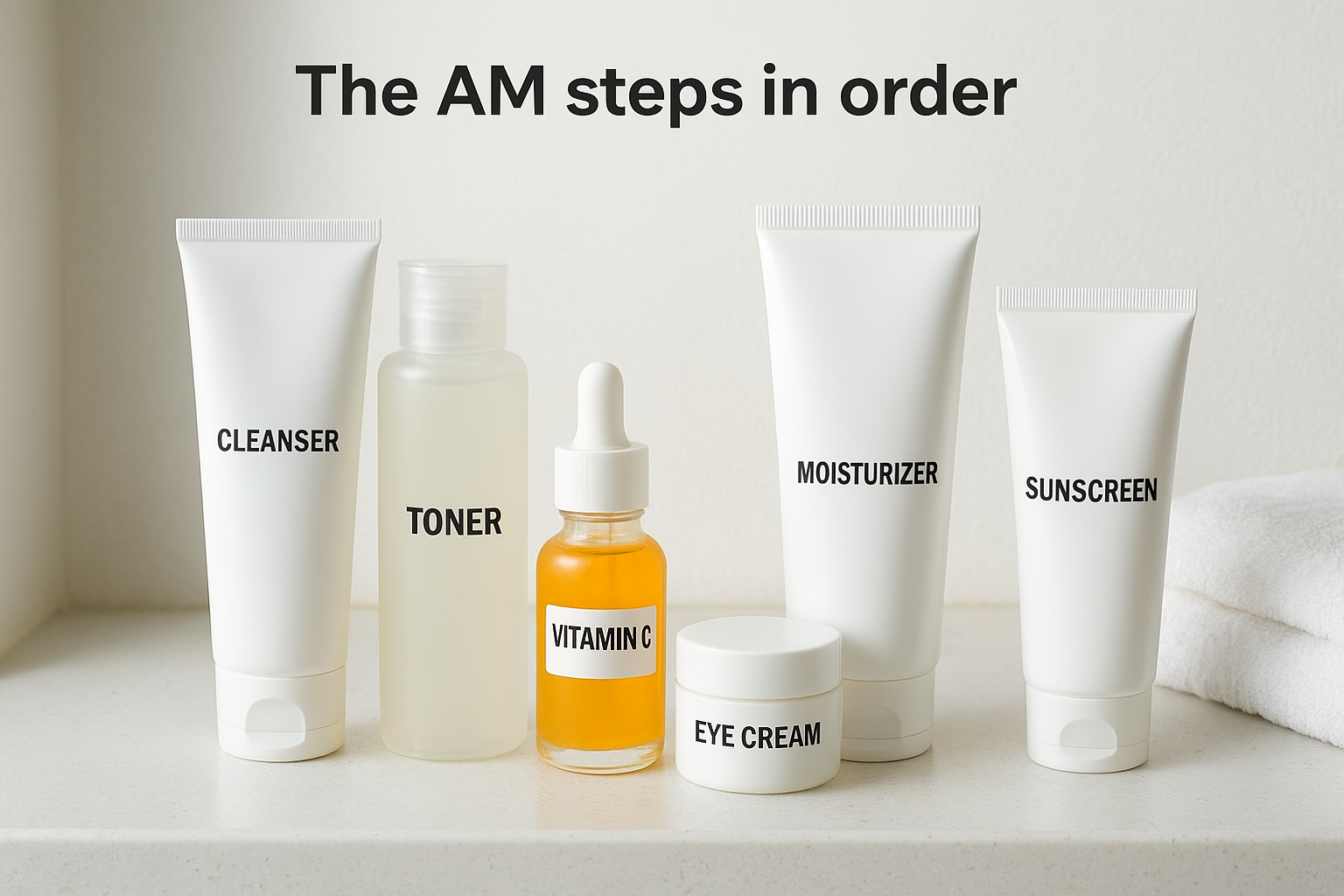
- Cleanser - Use a gentle, non-stripping face wash. If your skin isn't oily, a rinse with cool water is enough.
- Toner or essence - Apply to slightly damp skin using your hands or a cotton pad to prep and balance pH.
- Vitamin C serum - Pat a few drops onto clean skin and allow 60 seconds of absorption before the next step.
- Eye cream - Use your ring finger to tap a small amount around the orbital bone, not directly on the lid.
- Moisturizer - Apply in upward strokes to seal in the hydrating layers beneath it.
- Sunscreen (SPF 30 or higher) - Apply this as your absolute last step, every morning, regardless of weather or season.
SPF is non-negotiable in the morning. It protects your skin and every active ingredient you applied in the steps before it.
What to skip in the morning
Not every product in your collection belongs in your AM lineup. Retinol breaks down in sunlight and becomes far less effective when applied in the morning, so always save it for night. Heavy exfoliating acids like AHAs and BHAs also create unnecessary photosensitivity when used before UV exposure. You also don't need overnight masks or sleep treatments in the morning since those formulas are designed to absorb over several hours, not to be layered under sunscreen and then washed away by sweat or heat mid-day.
Night routine: step-by-step order
Your nighttime routine does something your morning routine can't: it works with your skin's natural repair cycle. While you sleep, your skin increases cell turnover and rebuilds its barrier, which means the products you apply at night have a longer window to absorb and a more receptive surface to work on. This is the right time to introduce stronger actives, richer moisturizers, and targeted treatments that would either break down in sunlight or create unnecessary sensitivity during the day.
The PM steps in order
Following the correct skincare routine order of products at night means you're stacking your routine so that each layer supports the one that follows it. Cleanser first to remove the day, actives next while skin is clear and receptive, then heavier hydration and occlusion to seal everything in overnight. Use this sequence every night:
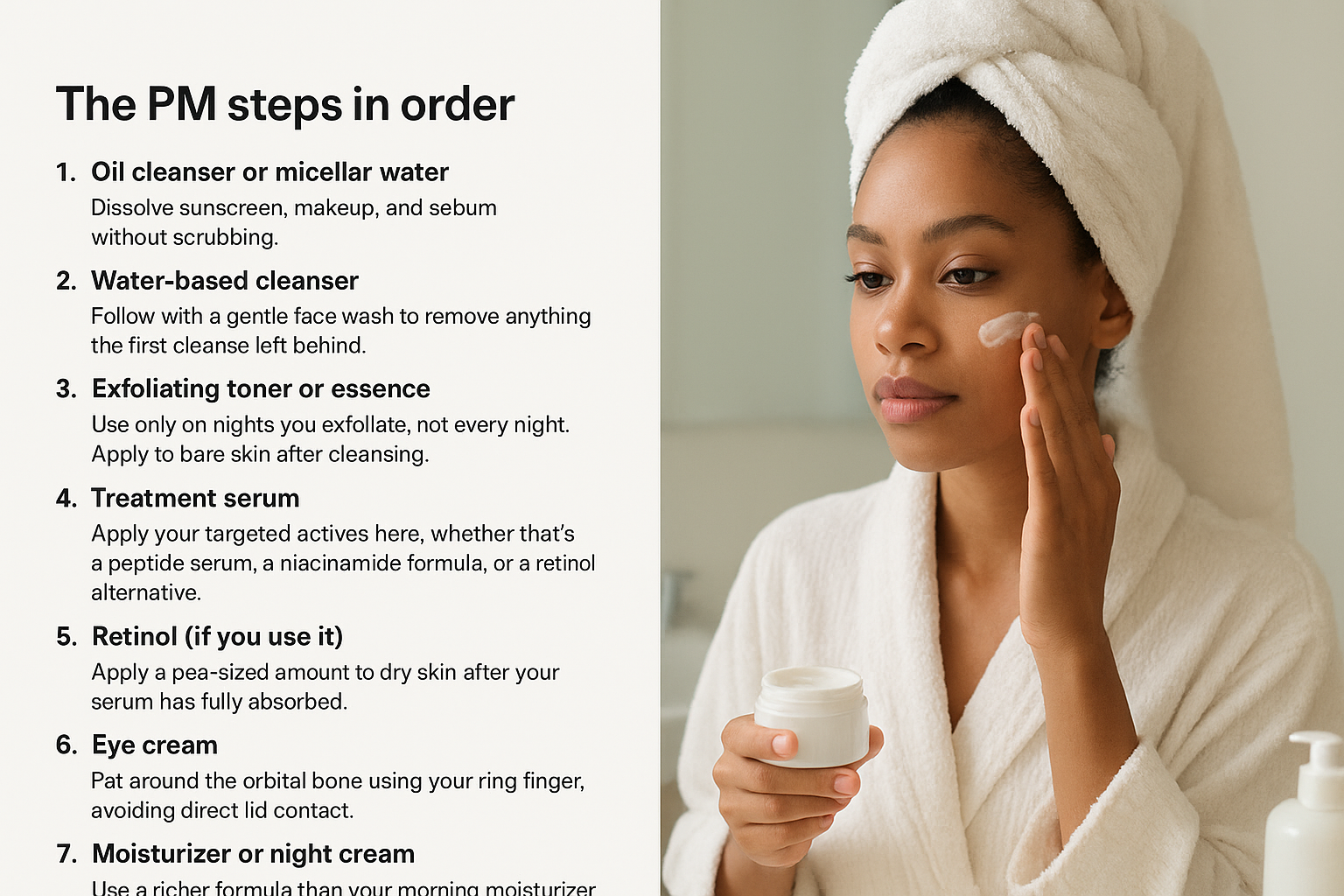
- Oil cleanser or micellar water - Dissolve sunscreen, makeup, and sebum without scrubbing.
- Water-based cleanser - Follow with a gentle face wash to remove anything the first cleanse left behind. This double-cleanse method keeps active ingredients from mixing with leftover SPF.
- Exfoliating toner or essence - Use only on nights you exfoliate, not every night. Apply to bare skin after cleansing.
- Treatment serum - Apply your targeted actives here, whether that's a peptide serum, a niacinamide formula, or a retinol alternative.
- Retinol (if you use it) - Apply a pea-sized amount to dry skin after your serum has fully absorbed.
- Eye cream - Pat around the orbital bone using your ring finger, avoiding direct lid contact.
- Moisturizer or night cream - Use a richer formula than your morning moisturizer to support overnight repair.
- Facial oil or sleeping mask (optional) - Apply as your final occlusive layer to lock in everything underneath.
Give retinol at least 60 seconds to absorb before applying your moisturizer on top, especially when you're first introducing it to your routine.
What makes night routines different
Your nighttime steps prioritize repair and penetration rather than protection. You don't need antioxidants for UV defense, and you don't need SPF, so you have room to use denser, more active formulas that would feel heavy or inappropriate under makeup. That freedom also means you need to be more intentional about what you combine and in what order, since actives applied incorrectly at night can disrupt your skin barrier while it's trying to rebuild.
Where exfoliants, masks, and treatments fit
Exfoliants, masks, and spot treatments don't belong in every routine, but knowing exactly where they slot in is just as important as knowing the order of your daily steps. These occasional additions are where most people get confused, either piling them on top of an already-full lineup or using them at the wrong point and undercutting their effectiveness. Placing each one correctly within your skincare routine order of products keeps your results consistent and your skin barrier intact.
Exfoliants: where they go and how often
Chemical exfoliants, including AHAs like glycolic acid, BHAs like salicylic acid, and the gentler PHAs, go directly after cleansing, before any serum or moisturizer. Apply them to bare, dry skin so they make direct contact with the surface cells they're designed to remove. On exfoliation nights, skip your regular toner and apply the exfoliant in its place instead. Limit chemical exfoliation to two or three times per week at most, and never stack multiple exfoliating acids in the same session.

Using an exfoliant on the same night as retinol doubles your irritation risk without doubling any benefit, so pick one or the other on any given night.
Physical scrubs follow the same placement rule: use them after cleansing on damp skin, then rinse fully before continuing with the rest of your routine. Unlike chemical exfoliants, physical scrubs rinse off completely, so you return to your normal serum and moisturizer steps right after patting dry.
Masks and spot treatments
Sheet masks and rinse-off clay masks go after toner but before your serum, since they're concentrated treatment steps that need direct skin contact to absorb. After removing a sheet mask, press the remaining serum into your skin and skip your moisturizer entirely since the mask replaces it. Clay masks pull out excess oil and surface impurities, so follow them with your regular serum and moisturizer to rehydrate after the clay draws moisture from the surface.
Spot treatments, whether benzoyl peroxide gels, sulfur formulas, or salicylic acid creams, go after your serum and before your moisturizer. Apply them only to the specific breakout area, allow 30 seconds of absorption, and then add your moisturizer over the top to prevent the surrounding skin from drying out.
How to layer actives without irritation
Active ingredients are the workhorses of your skincare routine order of products, but they're also the most likely source of irritation when combined carelessly. Retinol, vitamin C, AHAs, BHAs, and benzoyl peroxide all have strong chemical profiles that can conflict with each other, disrupt your skin barrier, or simply cancel each other out when you stack them wrong. Understanding which actives work together and which ones need to be separated is the difference between visibly better skin and a reactive, sensitized barrier.
Which actives clash
Not every ingredient conflict causes immediate redness or burning, but some combinations consistently create problems that build up over repeated use. Vitamin C is pH-dependent and works best in an acidic environment. Applying it right after an AHA, which also needs an acidic pH to activate, doesn't double your results. Instead, you overload the skin with competing acid-dependent formulas and increase your risk of sensitivity and barrier breakdown.
Retinol and benzoyl peroxide are another combination to keep apart. Benzoyl peroxide oxidizes retinol and renders it less effective on contact, so using both in the same step gives you the irritation of two strong actives with the benefit of neither. Similarly, retinol and exfoliating acids used on the same night strip the surface layer faster than your skin can recover, leading to peeling, tightness, and long-term barrier damage.
If your skin responds with redness, flaking, or persistent tightness, separate your actives by night rather than trying to adjust the layering order.
Timing and buffering strategies
Separating actives by time of day or by alternating nights is the most reliable way to prevent irritation without giving up results. Use vitamin C in the morning and retinol at night. Alternate exfoliation nights with retinol nights rather than combining both in the same session. This approach gives each active a clear window to work without competing with or inflaming your skin.
Buffering is another tool that reduces irritation from strong actives like retinol. Apply your moisturizer first, let it absorb for two minutes, then apply retinol on top. This slows the penetration rate of the retinol and lowers your chance of stinging or peeling, especially during the first few weeks of introducing it to your routine.
Common questions and quick fixes
Even with a solid understanding of your skincare routine order of products, specific situations come up that the basic rules don't cover. These are the most common sticking points people run into when building or adjusting their routine, along with direct fixes you can apply right away without overhauling everything.
Why is your skin pilling or not absorbing products?
Pilling almost always points to a layering order problem, not a product defect. When you apply a silicone-based product before a water-based one, the water-based formula has nothing to grip and rolls off the skin surface instead of absorbing. The fix is straightforward: check your product labels and rearrange so water-based formulas go on before silicone-heavy ones. Give each layer 30 to 60 seconds to absorb before adding the next step.
Here are the most common causes of pilling and how to fix each one:
| Problem | Likely Cause | Quick Fix |
|---|---|---|
| Products ball up on skin | Silicone-based product applied too early | Move silicone products to the end of your routine |
| Serum sits on top of skin | Heavy cream applied before serum | Reverse the order: serum always before moisturizer |
| SPF pills over moisturizer | Not enough absorption time between steps | Wait 60 seconds after moisturizer before applying SPF |
| Flaking after actives | Too many active layers applied at once | Cut back to core steps, then reintroduce products slowly |
Pilling tells you to fix your order, not replace your products.
What if you have too many products to fit into one routine?
Splitting your routine across your AM and PM slots solves this immediately without forcing you to cut products you still need. Vitamin C, antioxidant serums, and SPF belong in the morning. Retinol, heavier peptide serums, and rich overnight treatments belong at night. If your lineup still feels overcrowded, alternate your actives across different nights rather than stacking them all into a single session.
Consistent use of the right products in the right sequence always outperforms a maxed-out routine applied incorrectly. You don't need every product every day to see real improvement, and a focused, ordered routine used regularly will always deliver better results than a complicated one that irritates your skin.
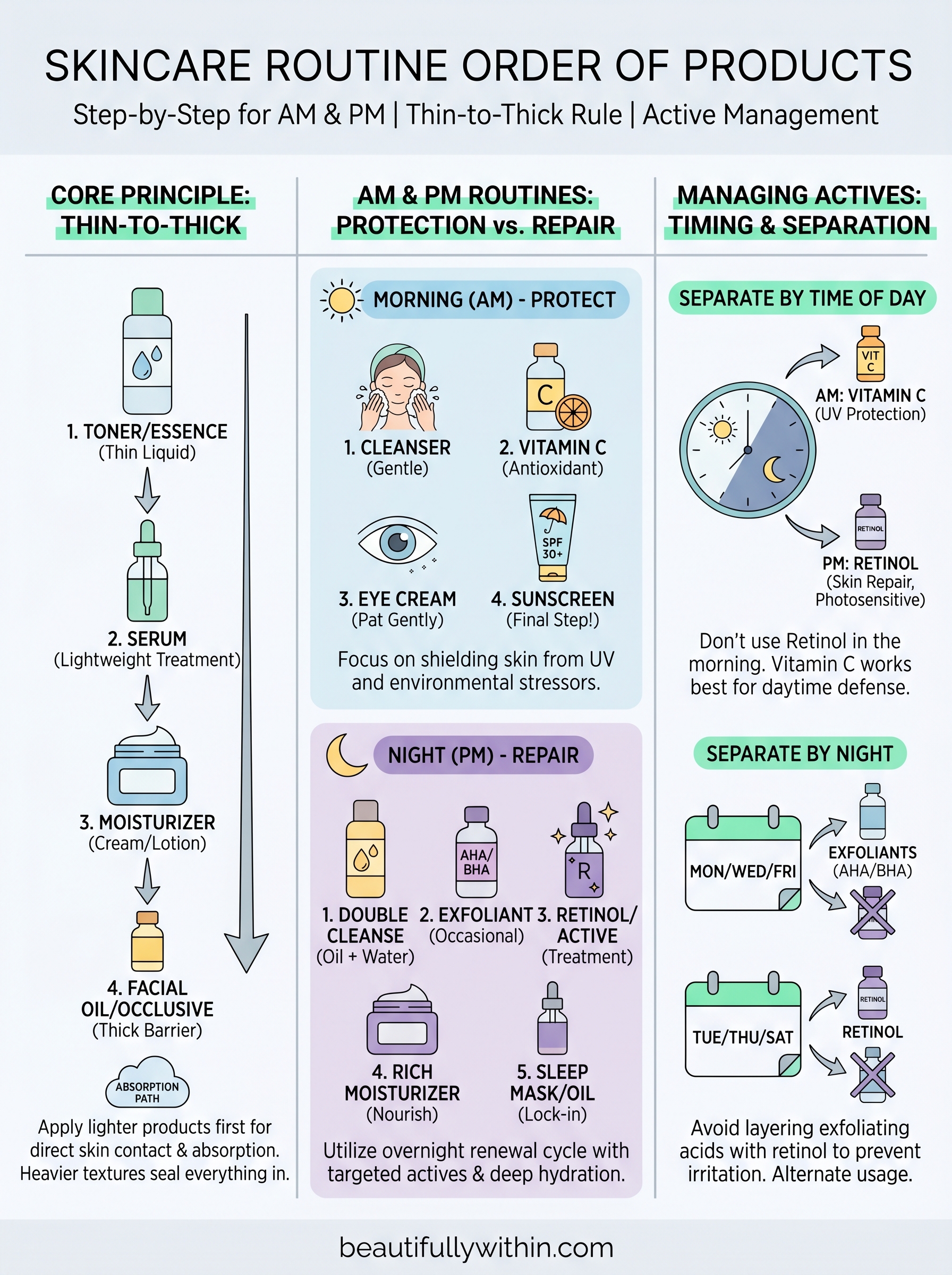
Final checklist
Your skincare routine order of products comes down to a few principles you can apply every single day. Thin to thick. AM for protection, PM for repair. Actives separated by time, not stacked on top of each other. Run through this list before your next routine:
- Cleanser first, always
- Toner or essence on damp skin, before serums
- Vitamin C in the morning, retinol at night
- Eye cream before moisturizer, patted gently
- Sunscreen as your final AM step, no exceptions
- Exfoliants and retinol on separate nights
- Spot treatments after serums, before moisturizer
- Facial oils and sleeping masks last
Consistency with the right steps beats a complicated routine applied incorrectly every time. If you want products that are worth layering correctly, browse the premium skincare collection at Beautifully Within and find formulas that match your skin type and goals.
✨ Shop the Look at Beautifully Within
Loved this guide? Discover our hand-picked picks that pair perfectly with your routine:
- 👉 Fresh Start Hydrating Cleanser & Toner Duo — Skincare Set
- 👉 Rice Brightening Skincare Collection — 6-Piece Ritual — Skincare Set
- 👉 Blueberry Radiance Skincare Collection — 4-Piece Set — Skincare Set
- 👉 Brightening Skincare Trio — Toner, Serum & Cream — Skincare Set
New customer? Get 15% off orders $50+ with code WITHIN15 — plus free shipping over $75.
0 comments