

You've got a cleanser, a serum, a moisturizer, maybe a toner you bought on impulse, and now you're staring at your bathroom counter wondering what goes on first. Sound familiar? Having your skincare routine explained step by step makes the difference between products that actually work and money washed down the drain. The order you apply each product matters more than most people realize, and getting it wrong can block active ingredients from reaching your skin at all.
This guide breaks down exactly what goes where, morning and night, so you can stop guessing and start building a routine that fits your skin, your concerns, and your schedule. Whether you're dealing with acne, dryness, sensitivity, or just want a solid foundation, every step here has a clear purpose.
At Beautifully Within, we help people find products that actually work for their skin type, because we've been through the trial-and-error ourselves. I've spent years testing what works on my own sensitive, reactive skin, and I know how frustrating it is to waste money on products that don't deliver. This article pulls from that hands-on experience to give you a straightforward starting point you can trust and build on over time.
What a skincare routine is and why order matters
A skincare routine is a deliberate sequence of products you apply to your face in a specific order, usually once in the morning and once at night. The goal isn't just to cleanse and moisturize. A well-built routine delivers active ingredients to your skin in the right concentration, at the right time, using the right vehicle. When you have your skincare routine explained properly, you realize it's less about how many products you own and more about how you use the ones you have.
The skin barrier and absorption basics
Your skin has a protective outer layer called the stratum corneum, and it's designed to keep things out, including many of the products you apply. This barrier function is both useful and limiting. Smaller molecules penetrate more easily than larger ones, which is why thin, watery serums go on before thick creams. Apply a heavy moisturizer first, and you physically block anything lighter from reaching the deeper layers where it can actually do something.
The skin barrier doesn't distinguish between a $10 drugstore serum and a $100 luxury one. If you layer products in the wrong order, neither one will perform as intended.
Understanding how your skin absorbs products also helps you make better purchasing decisions. You stop chasing the next trending ingredient and start asking whether the formulation and your application method actually give it a fair shot.
Why layering order changes everything
Think of your skincare products like a stack of filters. Each layer you apply affects how the next one performs. An oil applied before a water-based serum creates a barrier the serum can't fully penetrate. An exfoliating acid used after a thick moisturizer loses most of its direct contact with your skin. The sequence isn't a marketing idea. It's basic chemistry.
Products also interact with each other. Certain active ingredients destabilize or neutralize each other when applied in the wrong order or at the same time. Vitamin C oxidizes quickly when it contacts some formulations. Retinol loses effectiveness when layered directly over certain acids. Applying these in the right sequence, or separating them entirely, keeps each ingredient stable and working.
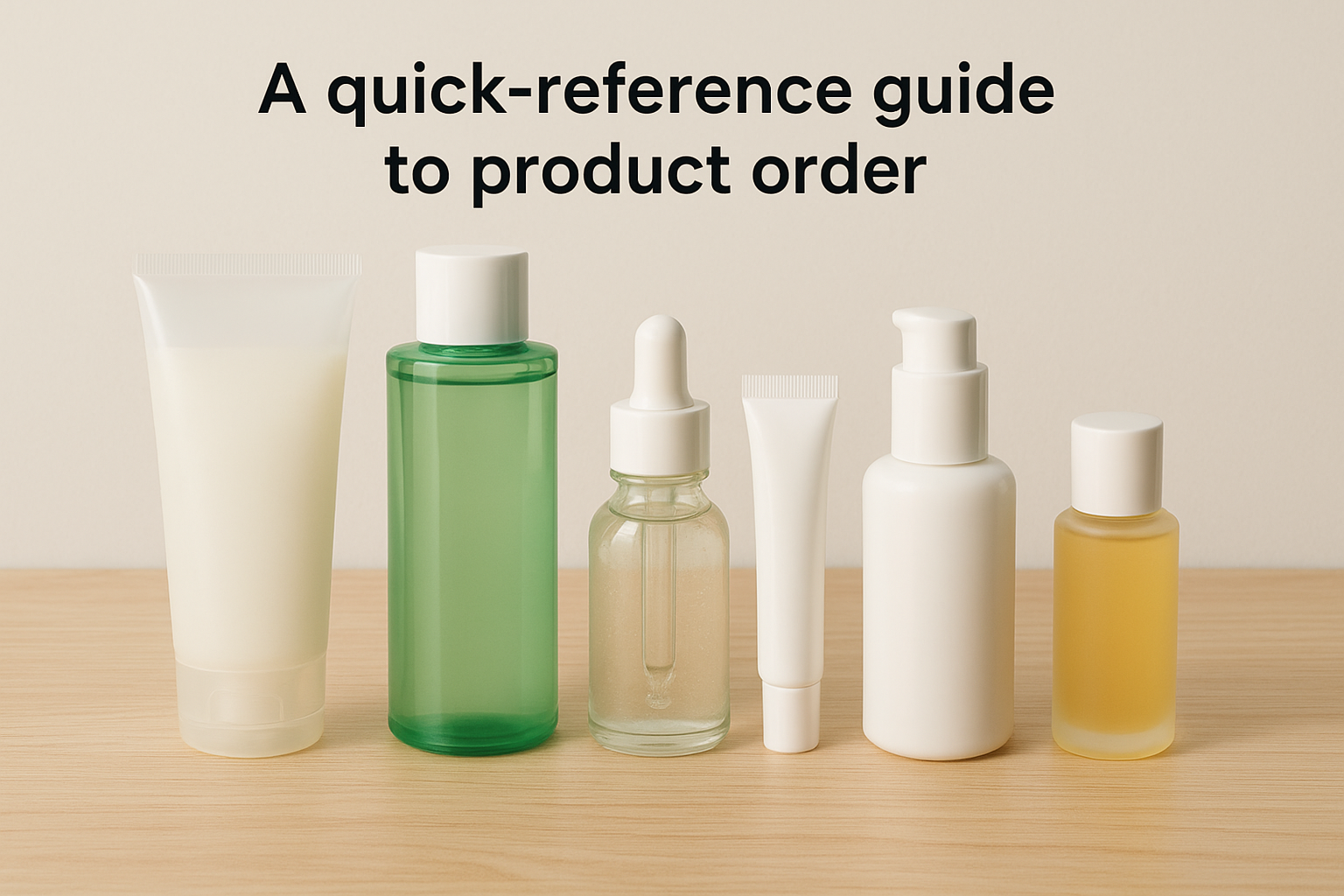
A quick-reference guide to product order
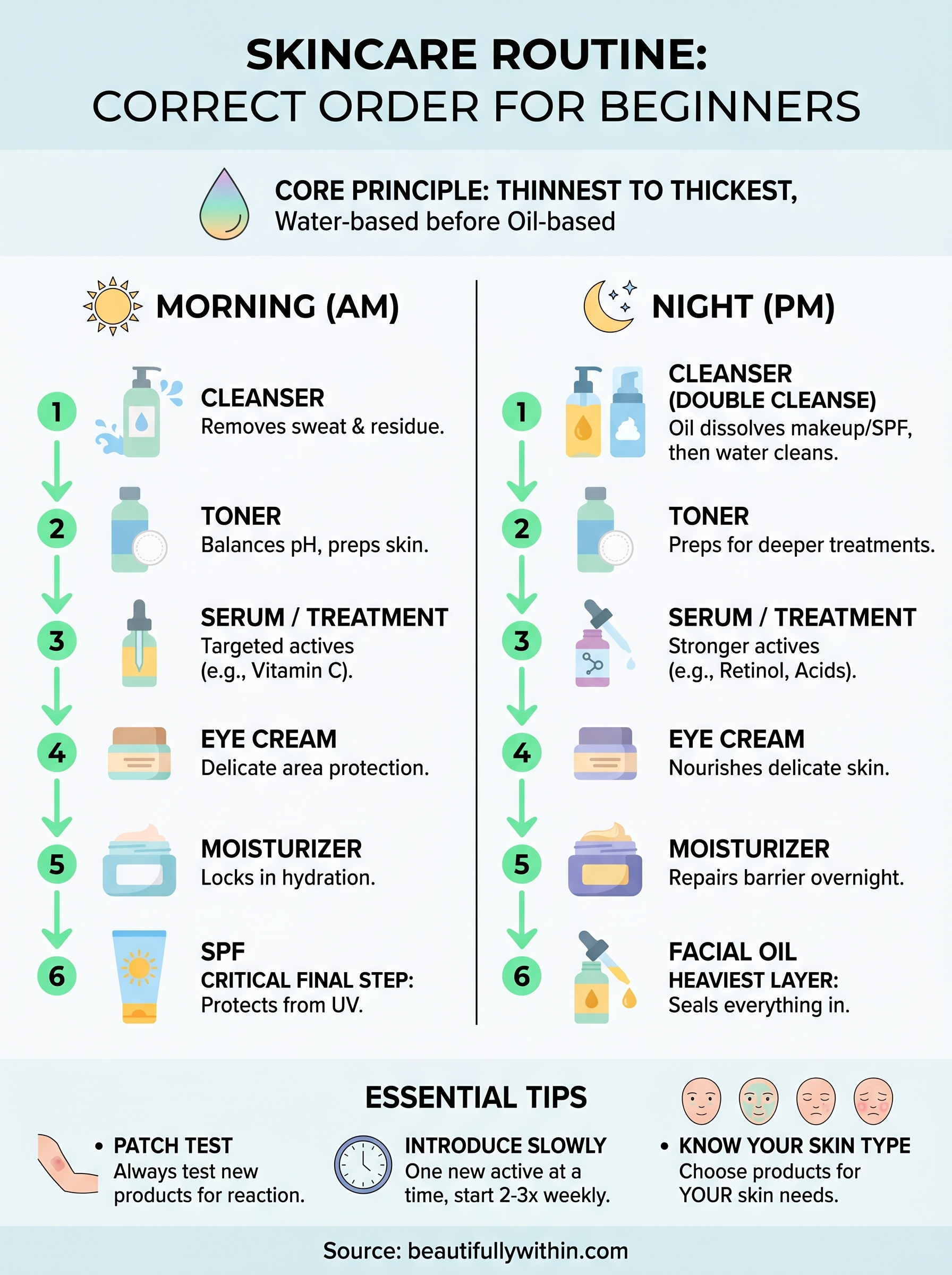
The principle that governs every routine is simple: thinnest to thickest, water-based before oil-based. This applies whether you're using two products or ten. Here's how a complete routine maps out:
| Step | Product Type | Why it goes here |
|---|---|---|
| 1 | Cleanser | Removes dirt and oil so products absorb cleanly |
| 2 | Toner | Balances pH and preps skin to receive actives |
| 3 | Serum / Treatment | Thin and concentrated, needs direct skin contact |
| 4 | Eye cream | Applied before heavier products so it isn't diluted |
| 5 | Moisturizer | Seals in previous layers and locks in hydration |
| 6 | SPF (AM only) | Always the final step in the morning |
| 6 | Facial oil (PM only) | Heaviest layer, locks everything in overnight |
Following this order doesn't mean every step is mandatory. You build from what your skin actually needs, not from what a full product lineup suggests. Start with the basics and add steps only when you have a clear reason to do so.
Start here: your skin type, goals, and sensitivities
Before you pick up a single product, you need to know what your skin actually is and what you want it to do. Skipping this step is how people end up with a drawer full of products that do nothing useful. Getting your skincare routine explained in the right context means understanding that no two people need the same lineup, and your skin type is the foundation every good routine is built on.
How to identify your skin type
The simplest test requires nothing but a clean face and 30 minutes. Wash your face with a gentle cleanser, skip every product, and wait. After 30 minutes, check how your skin feels and looks across different zones.
| Skin Type | What you notice after 30 minutes |
|---|---|
| Normal | Comfortable, no tightness, no excess shine |
| Oily | Shiny across the forehead, nose, and chin |
| Dry | Tight, flaky, or rough in texture |
| Combination | Oily in the T-zone, dry or normal on the cheeks |
| Sensitive | Redness, stinging, or visible irritation after contact |
Knowing your skin type prevents you from buying products formulated for the wrong skin entirely. An oily skin type using a heavy cream designed for dry skin will likely trigger breakouts. A dry skin type using a foaming cleanser meant for oily skin will feel stripped and uncomfortable within days.
Your skin type can shift with seasons, hormones, stress, or age, so reassess every few months rather than treating it as permanent.
Setting realistic goals for your routine
Once you know your skin type, write down your top two or three skin concerns in plain language. Examples: "I break out around my chin every month," "my skin feels tight after washing," or "I'm starting to notice fine lines around my eyes." Specific goals help you choose actives and treatments with a clear purpose instead of grabbing whatever has the best-looking label.
Avoid targeting too many concerns at once when you're starting out. Introducing multiple actives simultaneously makes it nearly impossible to know what's working and what's causing a reaction. Start with one concern, give it four to six weeks, and adjust based on what you actually see in the mirror.
Morning routine step-by-step for beginners
Your morning routine sets the foundation for how your skin handles everything the day throws at it, from UV exposure to pollution to dry indoor air. Every product you apply works best in a specific sequence, and changing that order can reduce how well each ingredient absorbs. Think of it as preparing a clean, primed surface before layering protection on top. With the skincare routine explained below, you'll know exactly what to use, in what order, and why each step earns its place.
Step 1: Cleanse
Start with a gentle, low-pH cleanser that removes sweat and overnight product residue without stripping your skin's natural oils. Your skin doesn't need an aggressive wash in the morning since you already cleaned it the night before. Dry and sensitive skin types do well with a micellar water or cream cleanser. Oily skin types can reach for a lightweight gel or foaming formula. Use lukewarm water and pat dry with a clean towel.
Step 2: Tone
Apply an alcohol-free toner to balance your skin's pH and prepare it to absorb the layers ahead. Look for ingredients like hyaluronic acid or niacinamide that add hydration rather than strip it. Press the toner gently into your skin with clean hands rather than wiping with a cotton pad to reduce unnecessary friction.
If your skin feels comfortable after cleansing, you can skip toning entirely and add it back when you have a clear reason to.
Step 3: Serum
Your serum is where targeted treatment happens, so pick one focused on your main concern. Vitamin C is a strong morning choice because it neutralizes free radicals from UV exposure and pollution and pairs well with sunscreen. Apply three to four drops and press them into your skin instead of rubbing, which spreads the product unevenly.
Step 4: Moisturizer and SPF
Lock in hydration by applying your moisturizer while the serum is still slightly damp so the two layers work together more effectively. Follow with a broad-spectrum SPF 30 or higher as your absolute final step every single morning. Use roughly a teaspoon for your face and extend it to your neck and ears. No morning routine is complete without sunscreen because UV exposure is the single biggest driver of every skin concern you're trying to fix.
Night routine step-by-step for beginners
Your nighttime routine does the heavy lifting while you sleep. Skin cell turnover accelerates overnight, which means the products you apply in the evening have a better opportunity to work than the same ones used in the morning. With the skincare routine explained for your evening, you're building a sequence that removes the day's buildup, treats your specific concerns, and gives your skin barrier everything it needs to repair itself before you wake up.
Step 1: Cleanse thoroughly
Start with an oil-based cleanser or micellar water to dissolve sunscreen, makeup, and sebum from the day. Oil breaks down oil, and a water-based cleanser alone often can't fully remove SPF residue. Follow immediately with your regular water-based cleanser to clear anything the first pass left behind. If you wore no makeup and skipped sunscreen, a single gentle cleanse is enough.
Pat your face dry with a clean towel and give your skin 30 to 60 seconds before moving to the next step. Applying products to completely dry skin helps certain actives, particularly retinol, absorb with less irritation than they would on damp skin.
Step 2: Tone and treat
Apply an alcohol-free toner by pressing it into your skin with clean hands. Nighttime is the right window for stronger treatment serums because your skin isn't facing UV exposure. Retinol, glycolic acid, and niacinamide all perform best in an evening routine. Apply a pea-sized amount of retinol to dry skin to reduce the chance of irritation, or press three to four drops of niacinamide into skin for overnight brightening.
Pick one active for your treatment step when you're starting out. Using multiple strong ingredients at the same time makes it impossible to know what's working and what's causing a reaction.
Step 3: Moisturize and seal
Use a slightly richer moisturizer at night than your morning formula, because your skin loses water as you sleep through a process called transepidermal water loss. Ingredients like squalane, shea butter, or ceramides in your night cream actively support barrier repair while you rest. Press the moisturizer in gently rather than rubbing, which reduces unnecessary friction on skin that's already working to recover.
Finish with a few drops of facial oil if your skin runs dry or your barrier feels compromised. Oils are the heaviest layer in your routine, so they go on last to seal everything underneath and prevent overnight moisture loss.
How to add actives without irritation
Active ingredients are the part of your skincare routine explained in the most confusing way online, with conflicting advice about layering, timing, and combinations. The reality is simpler: actives are potent, and your skin needs time to adjust to them. Introduce them too fast, and you get redness, peeling, and a barrier that's working against you instead of with you.
Introduce one active at a time
Adding a single active to your routine gives you a clear read on how your skin responds before you complicate the picture. Pick your top concern, choose an ingredient that addresses it directly, and use nothing else new for four to six weeks. If your skin reacts, you know exactly what caused it. If it improves, you know what's working.
Here's a straightforward reference for matching common concerns to starter actives:
| Skin Concern | Starter Active | When to Use |
|---|---|---|
| Acne and congestion | Salicylic acid (0.5-2%) | Evening |
| Dullness and uneven tone | Vitamin C (10-15%) | Morning |
| Fine lines and texture | Retinol (0.025-0.1%) | Evening |
| Dark spots | Niacinamide (5-10%) | Morning or evening |
| Dryness and dehydration | Hyaluronic acid | Morning or evening |
The low and slow method
Start with the lowest available concentration of any new active and use it two to three times per week rather than daily. Your skin builds tolerance over time, and jumping straight to daily use at full strength is how most people end up with a damaged barrier and a swollen face. After two weeks with no reaction, increase to every other day. After another two weeks, move to daily if your skin calls for it.
Buffering is a useful technique for retinol beginners: apply your moisturizer first, then add the retinol on top to reduce how much direct contact it has with bare skin.
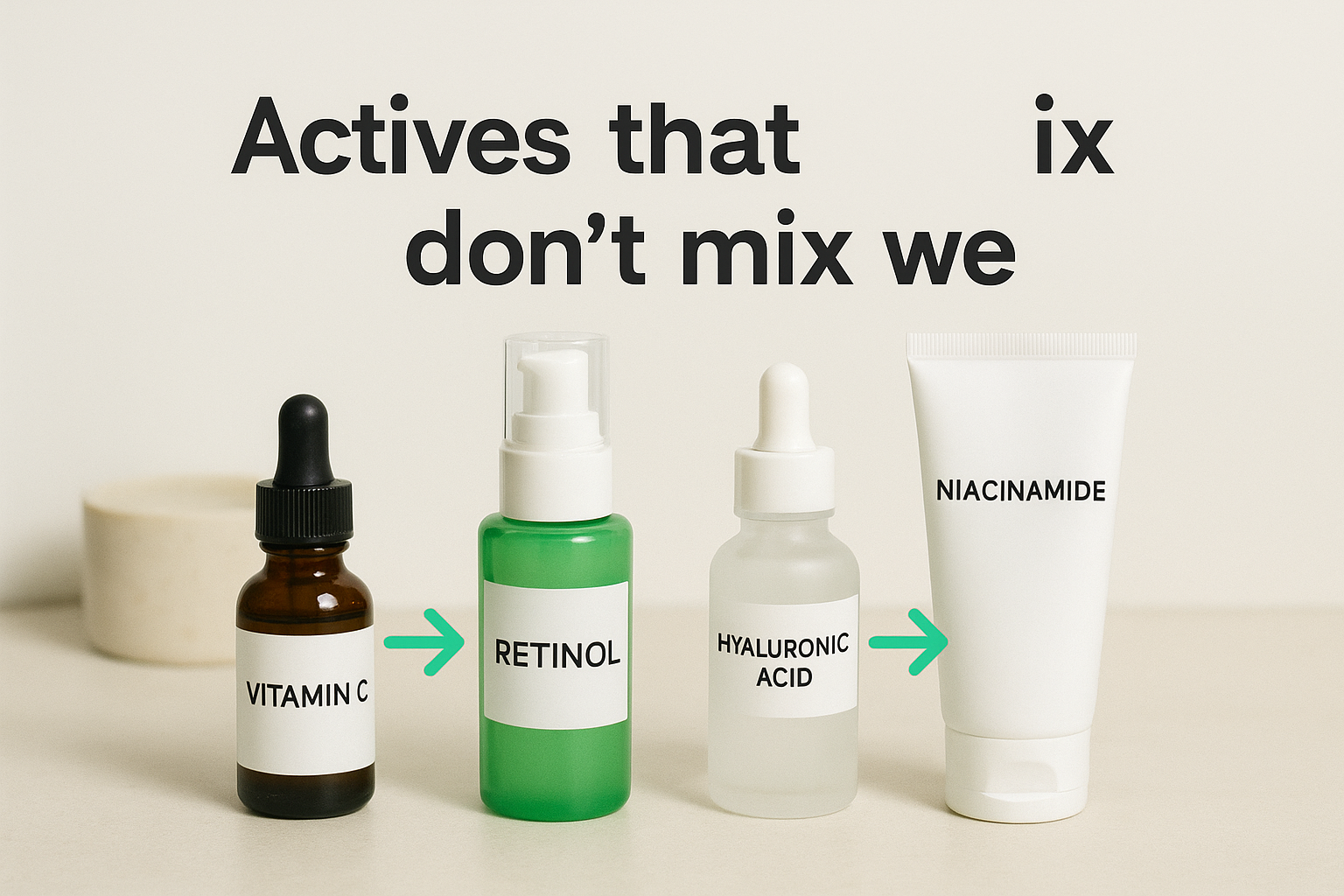
Actives that don't mix well
Some ingredient combinations cancel each other out or trigger irritation when used together in the same routine. The most common offenders are vitamin C with niacinamide (can cause temporary flushing in some skin types), and retinol with AHA/BHA acids (stacking them amplifies irritation significantly). Separate conflicting actives by using one in the morning and the other at night, or by alternating the evenings you use each one.
Weekly extras and when to skip them
Your daily routine handles the fundamentals, but weekly add-ons target texture, congestion, and hydration at a deeper level than everyday products can. The key word here is weekly. These extras are concentrated treatments, not daily steps, and using them too often is one of the fastest ways to compromise your skin barrier and trigger irritation. Understanding where they fit keeps your skincare routine explained clearly from daily basics through to targeted boosters.
Exfoliants: chemical vs. physical
Exfoliation removes the buildup of dead skin cells that dull your complexion and prevent your serums and moisturizers from absorbing properly. Chemical exfoliants do this with acids. Physical exfoliants use fine particles to manually buff the surface. For most beginners, chemical exfoliants cause less damage than physical scrubs, which can create micro-tears in the skin when used with too much pressure.
Start with one exfoliation session per week and only increase to two if your skin shows no signs of redness or sensitivity after four weeks.
Use the table below to match your skin type to the right exfoliant category:
| Skin Type | Recommended Exfoliant | Frequency |
|---|---|---|
| Oily or acne-prone | Salicylic acid (BHA) | 1 to 2x per week |
| Dry or dull | Lactic acid (AHA) | 1x per week |
| Sensitive | Mandelic acid (gentle AHA) | 1x per week or less |
| Normal or combination | Glycolic acid (AHA) | 1 to 2x per week |
Face masks and their timing
Face masks fall into two categories: hydrating masks that you apply and remove after 10 to 15 minutes, and clay or clarifying masks that draw out excess oil and congestion. Use a hydrating mask when your skin feels tight or stripped, particularly after sun exposure or a long flight. Apply a clay mask to your T-zone only if you run oily in that area, rather than across your entire face.
Apply both types to clean, toned skin before your serum and moisturizer so the active ingredients have direct contact with your skin surface and aren't competing with layers underneath.
When to skip your extras entirely
Skip every weekly extra when your skin barrier is visibly compromised: redness, peeling, stinging after washing, or a burning sensation when you apply your moisturizer are all signals to pull back. These are also the days to cut your routine down to a gentle cleanser and a plain moisturizer until your skin calms down. Adding more product to already reactive skin makes recovery slower, not faster.
Common mistakes and quick fixes
Even with the skincare routine explained step by step, most beginners run into the same handful of problems. The good news is that every mistake on this list has a straightforward fix, and catching them early saves you weeks of irritation and wasted product.
Piling on too many products too fast
The most common mistake is buying an entire routine at once and using everything from day one. Your skin cannot adjust to multiple new ingredients simultaneously, and when a reaction appears, you have no way to identify the cause. Fix this by starting with three products only: a cleanser, a moisturizer, and sunscreen. Add one new product every two to three weeks and track your skin's response before introducing the next step.
Keeping a simple notes app log with photos taken in the same lighting every two weeks gives you real evidence of what's working and what isn't.
Skipping or mistiming sunscreen
Many beginners either skip SPF entirely or apply it before their moisturizer. Sunscreen goes on last every single morning, after moisturizer but before makeup. Applying it too early buries it under other layers and reduces its ability to form an effective protective barrier on the surface of your skin. If you find the texture of a dedicated SPF off-putting, try a tinted mineral formula, which often feels lighter and doubles as light coverage.
Not patch testing before introducing something new
Patch testing takes two minutes and prevents days of recovery from a reaction. Apply a small amount of any new product to the inside of your wrist or behind your ear, wait 24 hours, and check for redness, itching, or swelling before putting it anywhere near your face. Most people skip this step and regret it quickly. Use the template below to build the habit:
| Day | Product tested | Area tested | Reaction noted |
|---|---|---|---|
| 1 | New serum | Inner wrist | No reaction |
| 2 | New moisturizer | Behind ear | Mild redness |
| 3 | New retinol | Inner wrist | No reaction |
If you notice any redness, itching, or swelling during a patch test, do not apply that product to your face. Return it if the retailer allows, or set it aside and try again on a day when your skin feels calm and your barrier is not already under stress.
Wrap-up and next steps
You now have the skincare routine explained from the ground up, starting with skin type identification and working through morning steps, evening steps, actives, weekly treatments, and the mistakes that slow most beginners down. The core principle stays the same throughout: apply products thinnest to thickest, introduce one new ingredient at a time, and give your skin four to six weeks before you judge results.
Your next step is simple. Start with a cleanser, a moisturizer, and SPF. Build from there only when your skin feels stable and you have a specific concern to address. Every product you add should earn its place with a clear purpose.
When you're ready to find products that actually fit your routine, browse the skincare collection at Beautifully Within for options suited to sensitive skin and real results. Your skin will thank you for starting right.
✨ Shop the Look at Beautifully Within
Loved this guide? Discover our hand-picked picks that pair perfectly with your routine:
- 👉 Fresh Start Hydrating Cleanser & Toner Duo — Skincare Set
- 👉 Rice Brightening Skincare Collection — 6-Piece Ritual — Skincare Set
- 👉 Brightening Skincare Trio — Toner, Serum & Cream — Skincare Set
- 👉 Blueberry Radiance Skincare Collection — 4-Piece Set — Skincare Set
New customer? Get 15% off orders $50+ with code WITHIN15 — plus free shipping over $75.
0 comments