

Byrdie has built a reputation for breaking down skincare into clear, actionable steps, and for good reason. Their routines are vetted by dermatologists and beauty editors who actually test what they recommend. If you've been searching for a Byrdie skincare routine that fits your specific skin type, you're already on the right track. But knowing which steps to follow, and in what order, can still feel like a puzzle with too many pieces.
Here's the thing most people get wrong: they layer products randomly or skip steps that their skin genuinely needs. Morning routines serve a different purpose than nighttime routines, and what works for oily skin can wreck sensitive or dry skin. Getting the order right matters just as much as the products themselves, sometimes more. A $12 serum applied at the right step can outperform a $90 one applied at the wrong time.
That's exactly why we put this guide together at Beautifully Within. We carry products across every category you'll need, from gentle face washes and targeted serums to moisturizers built for sensitive skin, and we believe the right routine should empower you to feel your best from the inside out. Below, you'll find a complete AM and PM step-by-step breakdown, organized by skin type, so you can build a routine that actually works for you.
What the Byrdie skincare routine is and why order matters
Byrdie is one of the most trusted beauty publications in the US, and their skincare content stands out because it explains the reasoning behind each step rather than just listing products. The Byrdie skincare routine framework is built around dermatologist-backed guidance, real product testing, and a consistent step-by-step order that applies whether you're building your first routine or refining one you've had for years. Their approach covers morning and evening routines separately, which is a key distinction that most generic skincare advice skips entirely.
What Byrdie's approach actually covers
Their routines are organized around a core set of product categories: cleanser, toner, treatment (serums and actives), moisturizer, and SPF in the morning. At night, that list shifts to include eye cream, heavier treatments, and a richer moisturizer or face oil. The structure isn't rigid for the sake of being rigid. Each step exists because skin absorbs and responds to ingredients in a specific sequence. Applying your moisturizer before your serum, for example, creates a physical barrier that blocks the active ingredient from reaching your skin cells where it actually does its work.
What makes the Byrdie framework particularly useful is that it adapts to real skin concerns. Their guidance addresses oily, dry, combination, sensitive, and acne-prone skin separately, with adjustments at both the ingredient and product level. You're not expected to follow a routine built for someone with completely opposite skin concerns.
Getting the product category right matters, but getting the sequence right is what determines whether those products actually deliver results.
Why layering order changes everything
Skincare products are formulated with specific pH levels, molecular weights, and delivery systems. Those variables directly affect the order they need to go on your skin. Lighter, water-based products like toners and serums absorb fastest and need to go on clean skin first. Heavier, oil-based products like moisturizers and face oils go last because they seal in everything underneath. If you reverse that order, the heavier product sits on top and physically prevents the lighter one from penetrating.
Here's a simple breakdown that captures the core layering logic:
| Product Type | Consistency | Goes On |
|---|---|---|
| Cleanser | Liquid or foam | First (rinse off) |
| Toner | Watery | Right after cleansing |
| Serum or treatment | Thin liquid or gel | Before moisturizer |
| Eye cream | Cream | Before moisturizer |
| Moisturizer | Cream or lotion | Near last |
| SPF (AM only) | Lotion or spray | Absolute last in AM |
| Face oil (PM only) | Oil | Final step in PM |
Actives add another layer of complexity on top of this. Ingredients like retinol, vitamin C, AHAs, and BHAs each have specific placement rules and don't always work well together in the same routine. We cover that in detail in Step 4. For now, the core principle to hold onto is that sequence isn't optional, and the reason each step falls where it does is backed by how your skin actually functions.
Step 1. Build your AM routine in Byrdie order
Your morning routine has one main job: protect your skin for the day ahead. The Byrdie skincare routine for AM focuses on hydration, antioxidant defense, and sun protection, in that order. Think of it as layering a shield over clean skin rather than trying to repair anything. At this point in the day, you're not correcting damage, you're preventing it from happening in the first place.
The six-step AM sequence
Every step in the Byrdie morning routine has a specific purpose, and skipping one can shift the effectiveness of the steps around it. Follow this sequence every morning, even on days when you're in a hurry and tempted to skip the middle steps.
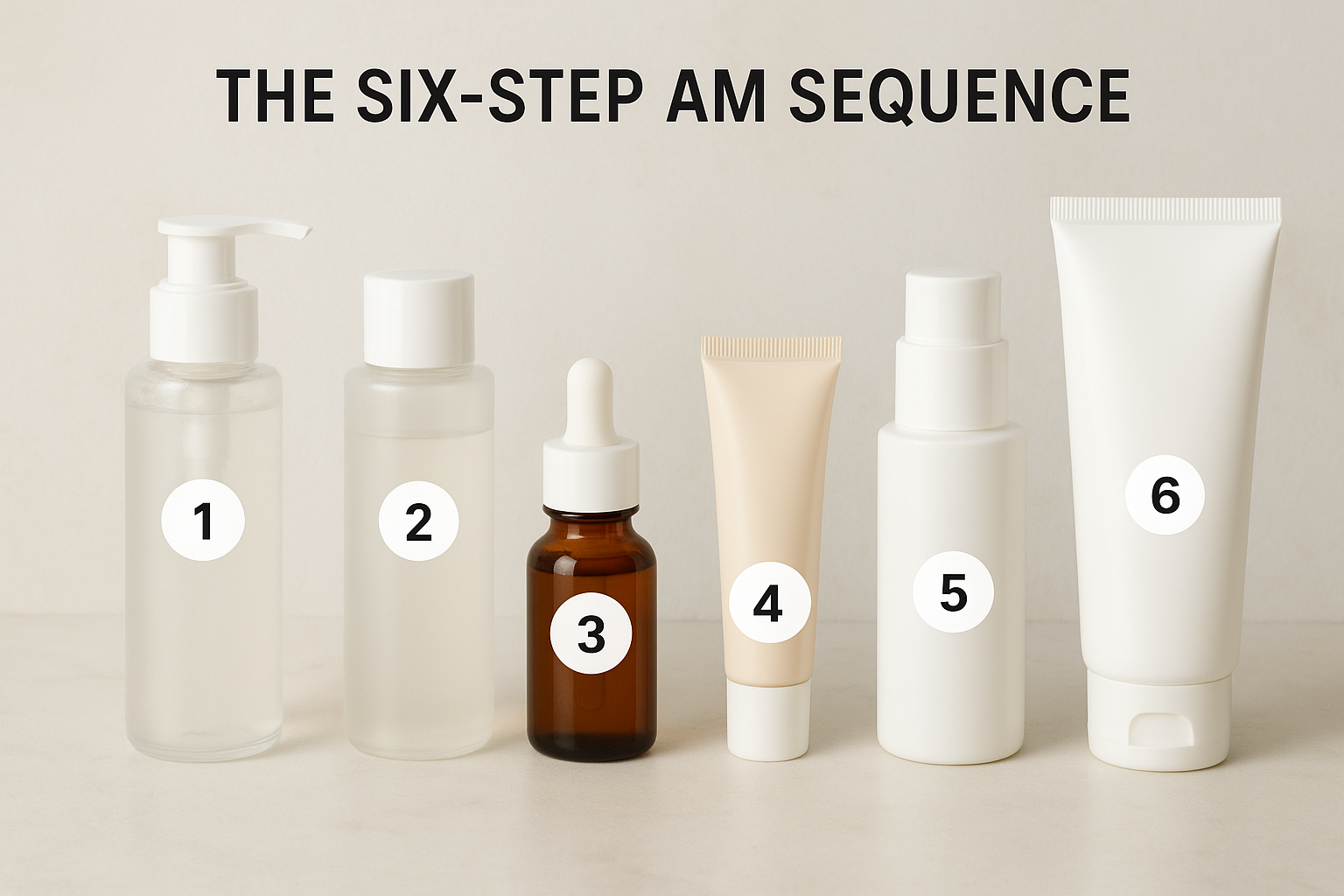
| Step | Product Type | Purpose |
|---|---|---|
| 1 | Gentle cleanser | Removes oil and sweat from overnight |
| 2 | Toner | Balances pH and preps skin for absorption |
| 3 | Vitamin C serum | Antioxidant protection against UV and pollution |
| 4 | Eye cream | Targets puffiness and fine lines around the eye area |
| 5 | Moisturizer | Locks in hydration and creates a smooth base |
| 6 | SPF 30 or higher | Blocks UV damage, the final and non-negotiable step |
SPF is the one product you cannot skip in a morning routine. Every other step supports it, but nothing replaces it.
How to apply each step correctly
Start with a gentle, pH-balanced cleanser and use lukewarm water, not hot. Hot water strips your skin's natural barrier before you've had a chance to reinforce it. Pat your face dry with a clean towel, don't rub, and move immediately to your toner while your skin is still slightly damp. Apply toner by pressing it into your skin with your palms rather than dragging a cotton pad across your face, this method reduces irritation and improves absorption.
Your vitamin C serum goes on next. Use two to three drops and press it evenly across your face and neck. Let it absorb for about 60 seconds before applying eye cream with your ring finger, using a tapping motion around the orbital bone. Follow with your moisturizer, which seals everything underneath it. Finish with a broad-spectrum SPF applied as a true final layer, not mixed into your moisturizer, because combining them dilutes the sun protection factor and you won't get full coverage.
Step 2. Build your PM routine in Byrdie order
Your evening routine has the opposite job from your morning one. At night, your skin enters repair mode, cycling through cellular renewal and collagen production while you sleep. The Byrdie skincare routine for PM leans into that biology by introducing heavier treatments, restorative ingredients, and richer moisturizers that would either break down under UV exposure or feel too heavy under makeup during the day. This is when retinol, peptides, and barrier-repair ingredients earn their place.
The PM step sequence
Night routines typically run one to two steps longer than morning routines because you're not capping everything with SPF. Instead, you're layering multiple treatments in a deliberate sequence, ending with something that locks moisture in overnight. Follow this order every evening for consistent results.
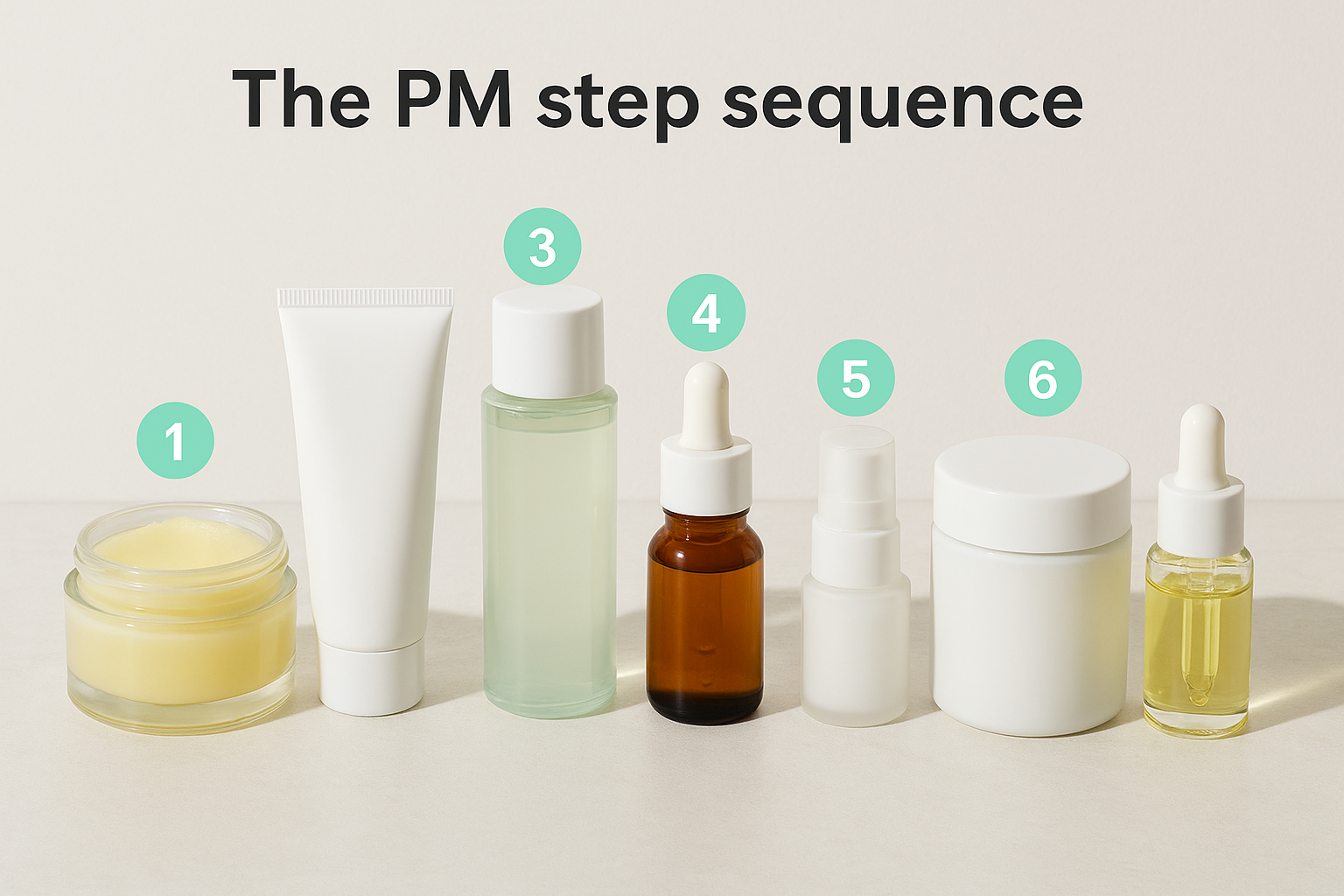
| Step | Product Type | Purpose |
|---|---|---|
| 1 | Oil cleanser or balm | Removes SPF, makeup, and sebum |
| 2 | Water-based cleanser | Deep cleans after oil cleansing (double cleanse) |
| 3 | Toner or essence | Rehydrates and preps skin for actives |
| 4 | Treatment serum | Targets specific concerns (retinol, niacinamide, peptides) |
| 5 | Eye cream | Supports collagen around the eye area overnight |
| 6 | Moisturizer | Seals in treatment ingredients |
| 7 | Face oil (optional) | Final occlusive layer for dry or compromised skin |
Double cleansing is not optional if you wore SPF or makeup during the day. A water-based cleanser alone cannot fully dissolve sunscreen or oil-based makeup.
How to apply each step correctly
Start with an oil cleanser, cleansing balm, or micellar water massaged across dry skin for 30 to 60 seconds before rinsing. Follow immediately with your water-based cleanser to clear what the first step loosened. This double cleanse method ensures your treatment serums absorb into genuinely clean skin rather than sitting on top of residual SPF or makeup film.
Apply your toner while skin is still slightly damp, then layer your treatment serum. If you use retinol, apply it to fully dry skin to reduce irritation. Wait 60 to 90 seconds between your serum and eye cream, then follow with your moisturizer. If you add a face oil, it goes absolutely last, on top of your moisturizer, not underneath it, because oil forms a seal that nothing else can penetrate once it's on.
Step 3. Adjust the routine for your skin type
The AM and PM steps covered above form the backbone of the Byrdie skincare routine, but that structure only delivers results when it fits your actual skin. Applying the same products in the same concentrations regardless of your skin type is one of the fastest ways to undo the good your routine is supposed to do. The adjustments below are targeted and specific, and they make a real difference in how your skin responds week over week.
The goal isn't a different routine for every skin type. It's the same structure with precise swaps at the right steps.
Oily and acne-prone skin
Your skin produces excess sebum, which means heavy occlusives and thick creams will clog your pores faster than they will for any other skin type. In the morning, swap a rich moisturizer for a lightweight, oil-free gel moisturizer containing niacinamide or salicylic acid. Skip the face oil entirely in your PM routine and replace it with a niacinamide or zinc serum that regulates oil production overnight. Use a foaming or gel cleanser both morning and evening rather than a cream-based formula, which can leave a residue that contributes directly to breakouts.
Dry and sensitive skin
Dry skin needs extra reinforcement at every barrier-sealing step, which means richer formulas and fewer actives running simultaneously. Use a cream or milk cleanser instead of a foaming formula. In your AM routine, layer a hyaluronic acid serum underneath your moisturizer to pull water into the skin before you lock it in with your cream. At night, add a face oil as the final step and choose one built around ceramides, squalane, or rosehip oil. Keep active ingredient concentrations low, especially with retinol, and introduce new products one at a time so you can identify irritants without guessing.
Combination skin
Combination skin means your T-zone behaves like oily skin while your cheeks behave like dry skin, so one product applied uniformly across your face often fails both zones at once. Start with a gentle, balanced cleanser that neither strips nor adds oil. At the moisturizer step, apply a lightweight gel formula to your T-zone and a slightly richer cream to your cheeks and jaw. This two-product approach takes an extra 30 seconds but delivers targeted results that a single universal moisturizer cannot match consistently.
Step 4. Use actives safely and avoid bad combos
Active ingredients are the most powerful tools in any Byrdie skincare routine, and they're also the easiest to misuse. Most irritation, peeling, and unexpected breakouts trace back not to a single product being "too strong" but to two actives competing for the same absorption window or canceling each other out at the pH level. Learning which actives belong in your AM routine, which belong at night, and which should never share a session keeps your barrier intact while your skin actually improves.
Using more actives at once does not speed up your results. It usually delays them by triggering a cycle of irritation and recovery.
Which actives to separate by routine
The simplest rule for managing actives is to keep your most potent ingredients on opposite sides of the day. Vitamin C is an antioxidant that works alongside UV protection, which makes it a morning active. Retinol breaks down under UV exposure and causes photosensitivity, so it belongs strictly at night. AHAs and BHAs are typically PM-only as well because both exfoliate the surface layer and temporarily raise your skin's sensitivity to sun damage.
Use this table as your reference when building out your active schedule:
| Active | Routine | Pairs Well With | Avoid Combining With |
|---|---|---|---|
| Vitamin C | AM | SPF, niacinamide | AHA, BHA, retinol |
| Retinol | PM | Peptides, ceramides | AHA, BHA, vitamin C |
| AHA (glycolic, lactic) | PM | Hyaluronic acid | Retinol, vitamin C, BHA same session |
| BHA (salicylic acid) | PM | Niacinamide | Retinol, AHA same session |
| Niacinamide | AM or PM | Almost everything | High-dose vitamin C |
How to introduce a new active without wrecking your skin
Start with the lowest available concentration of any new active and apply it once or twice per week before building toward nightly or daily use. Your skin needs time to build tolerance, and rushing that process forces your barrier into a repair cycle that stalls all your other progress. When adding a second active, wait at least three weeks after introducing the first one so you can isolate which product causes any reaction that appears.
Follow this sequence when adding a new active:
- Patch test on your inner arm for 48 hours before applying to your face
- Apply to your face once during the first week, twice during the second
- Increase to three times per week on the third week if no irritation appears
- Move to nightly or daily use only once your skin shows zero reaction at the lower frequency
Step 5. Add weekly extras without damaging your barrier
Weekly treatments like exfoliating masks, clay masks, and hydrating sheet masks can push your results further than your daily routine can alone. But they also carry the highest risk of barrier disruption when you stack them carelessly or use them too frequently. The Byrdie skincare routine framework treats these extras as intentional additions, not random experiments, which means scheduling them the same way you schedule your actives.
More isn't better with weekly treatments. One well-placed mask does more for your skin than three competing ones applied in the same week.
Which weekly extras actually move the needle
Not every add-on deserves space in your routine. The ones below have a clear purpose and a specific window in the week where they belong. Mixing categories across the same night guarantees you'll trigger irritation rather than improvement.
| Treatment | Skin Type | Frequency | Best Night |
|---|---|---|---|
| AHA exfoliating mask | Dull, dry, aging | 1x per week | Tuesday or Wednesday |
| BHA/clay mask | Oily, acne-prone | 1x per week | Thursday or Friday |
| Hydrating sheet mask | Dry, sensitive, all types | 2x per week | Any night |
| Enzyme mask | Sensitive, dull | 1x per week | Weekend |
| Facial scrub (gentle) | Normal, combination | 1x per week | Do not pair with AHA/BHA night |
Skip your active serum on any night you use an exfoliating mask. You're already exfoliating, and doubling up sends your barrier into recovery mode instead of renewal mode.
How to fit extras into your existing week
Start by mapping your current active schedule on paper or in your phone's notes app. Mark the nights you already use retinol, AHAs, or BHAs. Your weekly extras go on the remaining nights, specifically the ones with no actives already scheduled. If you use retinol on Monday and Thursday, your exfoliating mask fits cleanly on Wednesday, and your hydrating mask can land on Saturday.
Follow this scheduling template to avoid conflicts:
- Monday: Retinol
- Tuesday: Hydrating sheet mask
- Wednesday: AHA exfoliating mask (no retinol)
- Thursday: Retinol
- Friday: Clay or BHA mask (no retinol)
- Saturday: Hydrating sheet mask or enzyme mask
- Sunday: Rest night, use only cleanser and moisturizer
Sunday as a rest night gives your barrier 24 hours to consolidate before the week's actives start again.
Quick recap
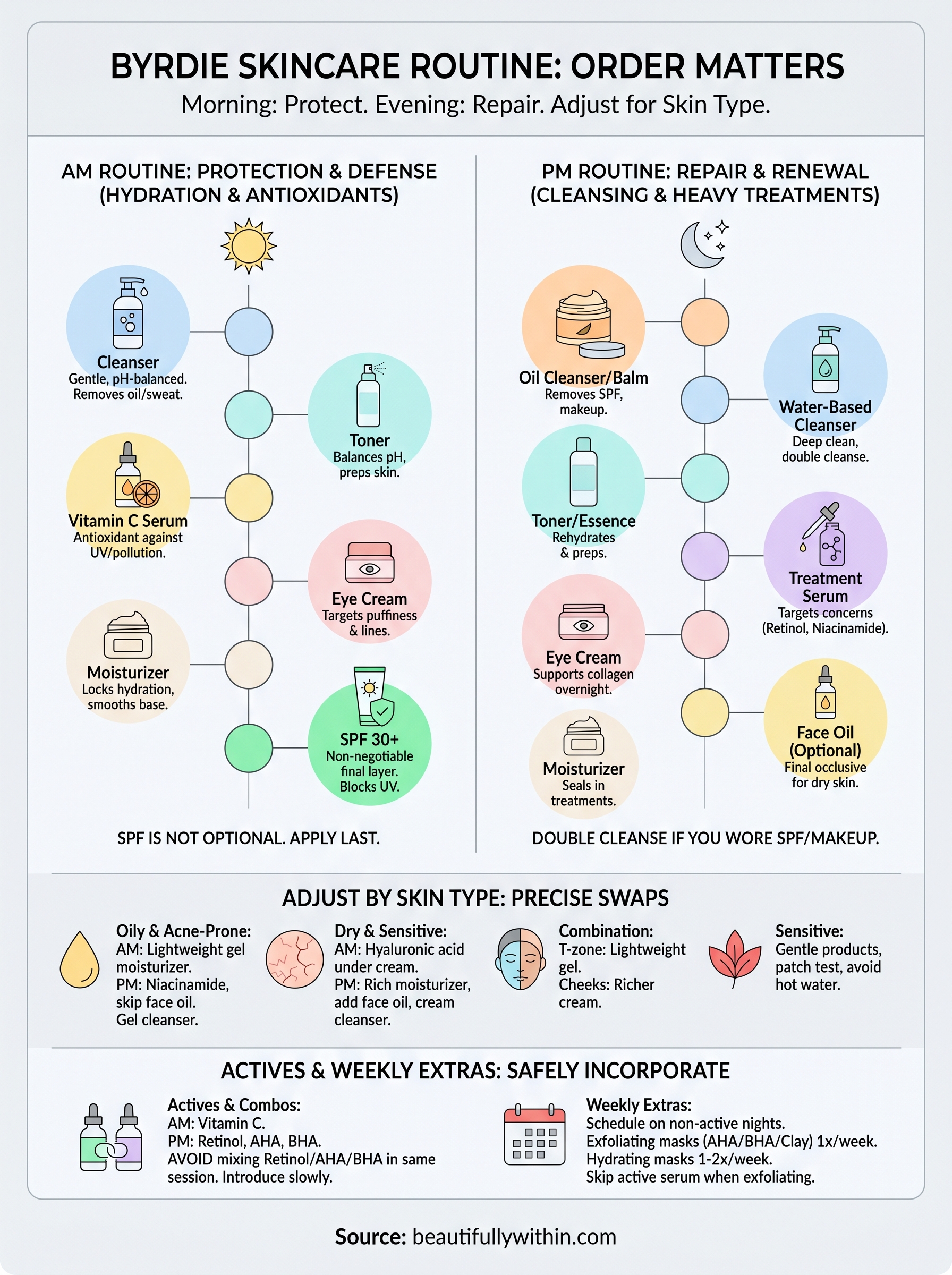
The Byrdie skincare routine works because every step has a reason, and the sequence locks in those reasons. Your AM routine focuses on protection and antioxidant defense, ending always with SPF. Your PM routine shifts toward repair, starting with a double cleanse and finishing with your richest treatment layer. Skin type adjustments happen at specific steps, not across the whole routine, and actives stay separated by time of day to prevent irritation. Weekly extras fit into the gaps your actives leave open, not on top of them.
Start with the basics and add complexity only after your skin responds well to what's already in place. One strong, consistent routine beats five competing products applied in the wrong order every time. If you're ready to build yours with products that support every step, explore the premium skincare collection at Beautifully Within and find exactly what your skin needs to move forward.
✨ Shop the Look at Beautifully Within
Loved this guide? Discover our hand-picked picks that pair perfectly with your routine:
- 👉 Fresh Start Hydrating Cleanser & Toner Duo — Skincare Set
- 👉 Rice Brightening Skincare Collection — 6-Piece Ritual — Skincare Set
- 👉 Brightening Skincare Trio — Toner, Serum & Cream — Skincare Set
- 👉 Blueberry Radiance Skincare Collection — 4-Piece Set — Skincare Set
New customer? Get 15% off orders $50+ with code WITHIN15 — plus free shipping over $75.
0 comments