

Dermstore has built a reputation for curating dermatologist-recommended brands, and their approach to layering products morning and night has become a go-to reference for skincare enthusiasts. If you've been searching for a dermstore skincare routine that actually makes sense for your skin type, you're in the right place. The steps are straightforward once you understand the logic behind product order and ingredient pairing.
Here at Beautifully Within, we believe great skin starts with knowing exactly what to put on your face, and when. We carry many of the same skincare categories Dermstore highlights, from cleansers and serums to SPF and overnight treatments, all chosen with sensitive skin and real-world results in mind. Our own experience testing products (and wasting money on ones that didn't deliver) taught us that a structured routine beats guesswork every single time.
This guide breaks down a complete AM and PM skincare routine step by step, drawing from Dermstore's recommended approach and pairing it with practical tips you can start using tonight. You'll learn which products go on first, why certain actives belong only in your evening routine, and how to adjust each step based on your specific skin concerns. Whether you're building a routine from scratch or tightening up what you already do, this walkthrough covers both halves of your day so nothing gets missed.
What to know before you build your routine
Before you buy a single product, you need to understand two foundational rules that determine whether your routine actually works: product order and ingredient compatibility. Most skincare failures happen not because a product is bad, but because it's applied in the wrong sequence or combined with something that cancels it out. Getting these basics right saves you money, time, and a lot of frustration.
The layering rule that makes everything else work
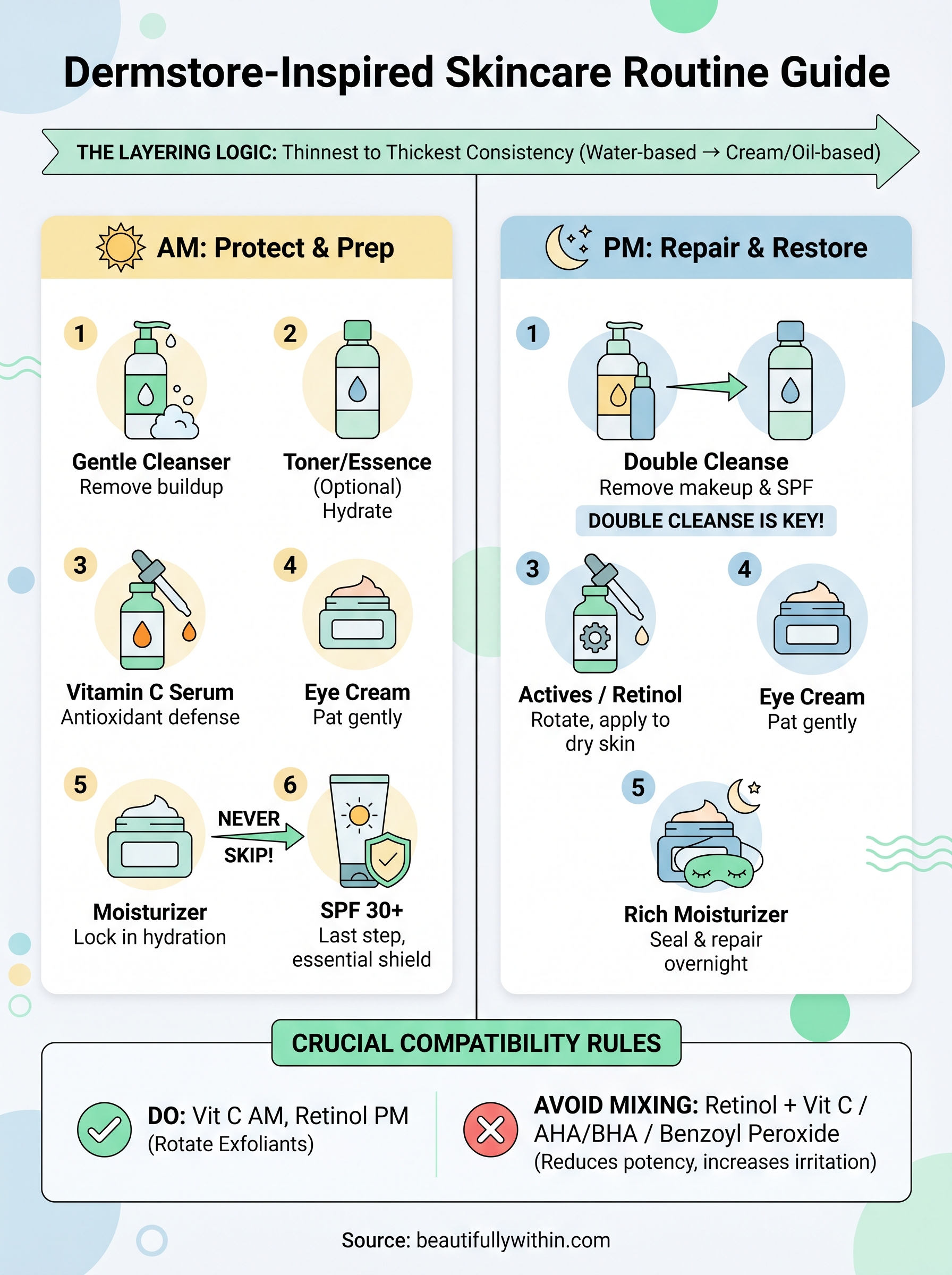
Skincare follows one core principle: apply products from thinnest to thickest consistency. Your skin can only absorb what reaches it, so if you layer a heavy moisturizer before a lightweight serum, the serum sits on top of a barrier it can't penetrate. Think of each layer as a door that needs to open in the right order for the next one to get through.
Apply products in order of water content, moving from the most watery formulas to oils and creams last.
Here is the general sequence that dermatologists and the Dermstore skincare routine approach both follow:
- Cleanser
- Toner or essence (optional but useful for dry or dehydrated skin)
- Treatment serums (vitamin C, niacinamide, hyaluronic acid)
- Eye cream
- Moisturizer
- SPF (AM only) or facial oil or sleeping mask (PM only)
This order applies to both your morning and evening routines, with specific product swaps depending on the time of day.
Know your skin type before you shop
Identifying your skin type is the single most important step before you build any routine. Products formulated for oily skin can strip dry skin raw, and rich creams that suit dry skin can clog pores on acne-prone faces. The most practical categories to know are normal, dry, oily, combination, and sensitive, since most product recommendations break down along these lines.
A quick way to identify where you fall: wash your face with a gentle cleanser, skip all products, and check in after 60 minutes. If your skin feels tight and looks flaky, it leans dry. If it looks shiny all over, it's oily. If shine appears only in your T-zone while your cheeks feel comfortable or tight, you have combination skin. Sensitive skin usually signals itself through redness, stinging, or itching within minutes of applying a new product.
Ingredients that don't play well together
Certain active ingredients reduce each other's effectiveness or cause irritation when you use them in the same routine. Understanding which pairings to avoid protects your skin barrier and keeps each product working the way it should. The most common conflicts involve retinol, vitamin C, and exfoliating acids like AHAs and BHAs.
| Combination to avoid | Why it causes problems |
|---|---|
| Retinol + AHA/BHA | Both exfoliate; layering them increases peeling and sensitivity |
| Vitamin C + niacinamide | Can reduce the potency of both actives |
| Retinol + vitamin C | Different pH requirements make them compete; irritation risk rises |
| Benzoyl peroxide + retinol | Benzoyl peroxide oxidizes and degrades retinol on contact |
The simplest fix is to keep vitamin C in your morning routine and retinol strictly at night, then rotate any exfoliating acids to alternate evenings rather than applying them daily.
Step 1. Build your morning routine in the right order
Your morning routine sets the tone for your skin's behavior throughout the day. Applying products in the correct sequence ensures each one absorbs properly and delivers the full benefit it promises. The dermstore skincare routine framework treats the morning as a time to protect and prep, not strip or over-treat, which means keeping the product count lean and purposeful.
Start with a clean base
Every morning routine begins with a cleanser, even if your skin feels clean from the night before. Overnight, your skin accumulates sweat, sebum, and residue from your PM products, and starting fresh gives your subsequent layers a clear path to absorb. Use a gentle, sulfate-free cleanser suited to your skin type and rinse with lukewarm water to avoid disrupting your moisture barrier. If you have dry or sensitive skin, a water rinse alone can work in the morning instead of a full cleanse.
Skipping your morning cleanse leaves overnight buildup between your skin and your serum, which blocks absorption and wastes product.
After cleansing, apply a toner or hydrating essence if your skin is dehydrated or if you plan to layer multiple serums. Pat it in gently and wait 30 seconds before moving to the next step.
Layer your actives and eye cream
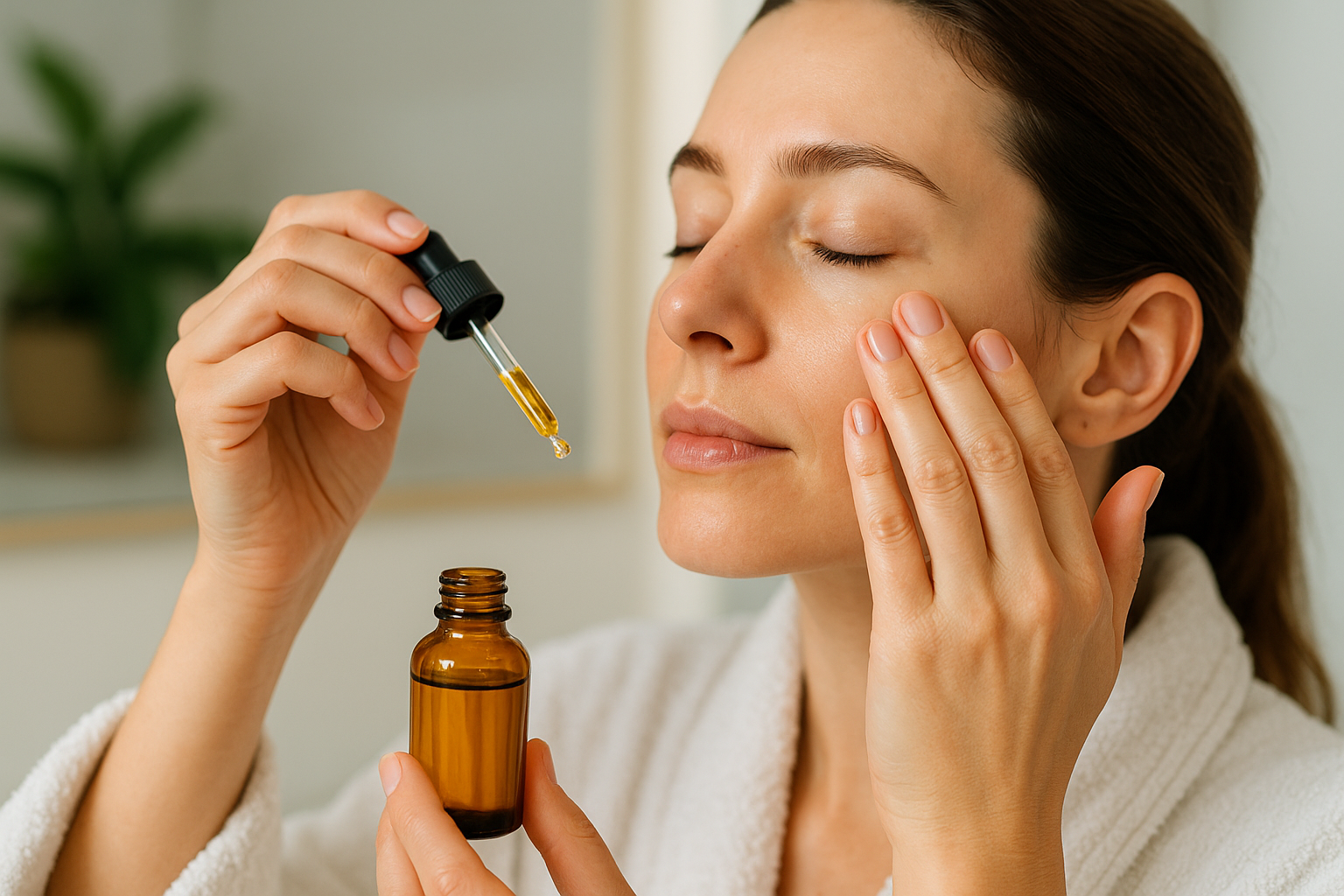
Morning is the right time for vitamin C serum, since it neutralizes free radicals from sun and pollution exposure throughout the day. Apply a few drops to dry skin and press it in with your fingertips rather than rubbing, which reduces friction and product waste. Follow with your actives in this order:
- Vitamin C serum
- Hyaluronic acid or niacinamide (if needed)
- Eye cream, patted gently around the orbital bone with your ring finger
Lock it in with moisturizer and SPF
Apply your moisturizer while skin still feels slightly damp from your serum to lock in hydration. Finish with a broad-spectrum SPF 30 or higher, applied as the very last step in your morning routine.
SPF forms a protective film over your skin, which means it needs to sit on top of everything else to work correctly. Never mix SPF into your moisturizer or apply it before other products, since diluting or layering it underneath reduces its UV protection.
Step 2. Build your nighttime routine in the right order
Your nighttime routine does a different job than your morning one. Instead of protecting skin from environmental damage, it focuses on repair and restoration while you sleep. This is when your skin cell turnover peaks, which means the products you apply at night have direct access to skin that's actively regenerating. Keep this in mind as you build out your PM steps from the dermstore skincare routine framework.
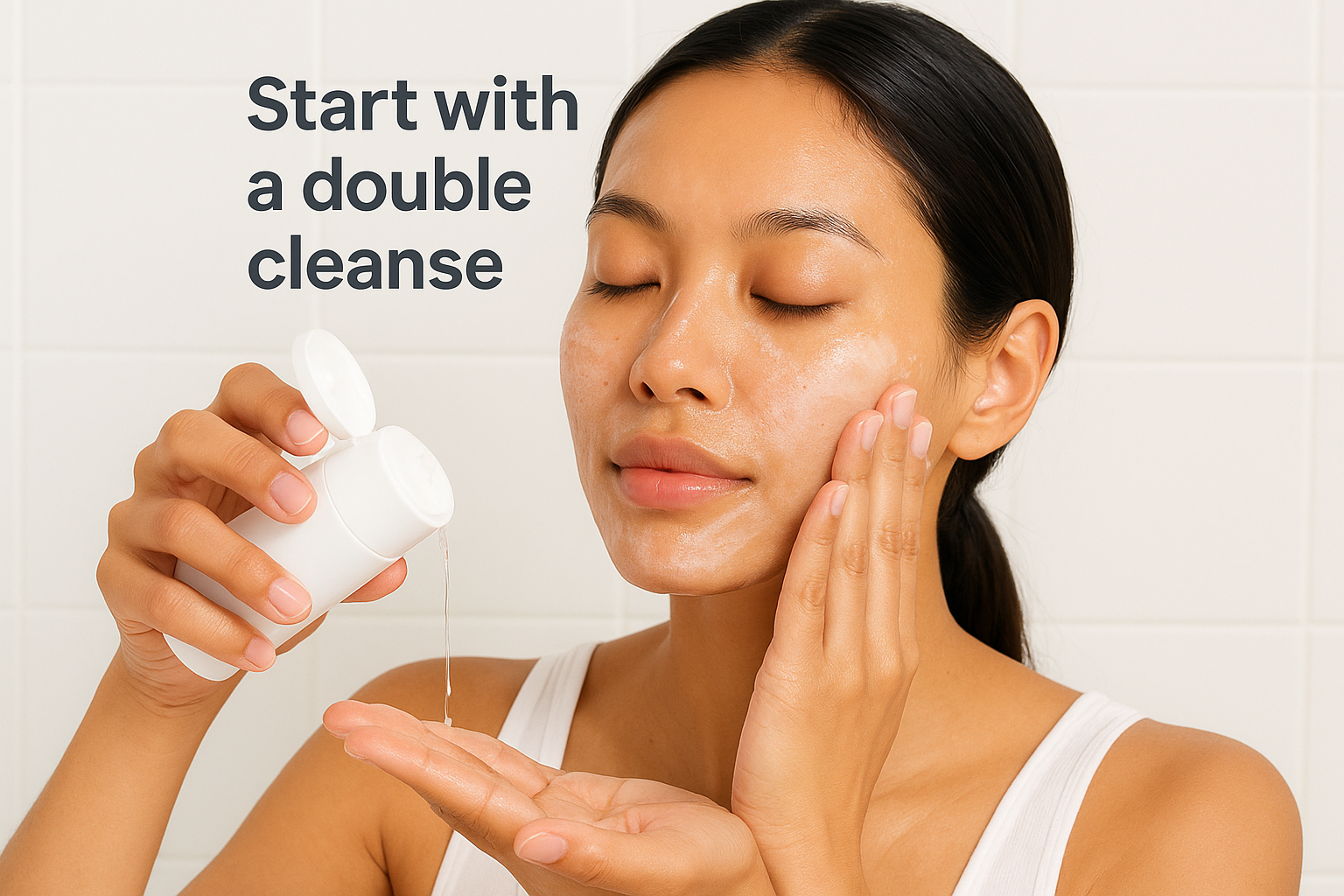
Start with a double cleanse
Double cleansing is the most important step you can take before any nighttime treatment, especially if you wear makeup, SPF, or both during the day. Start with an oil-based cleanser or micellar water to break down sunscreen, makeup, and excess sebum, then follow with your regular water-based cleanser to clear away any remaining residue and surface debris.
Skipping the first cleanse and going straight to a water-based formula leaves SPF and makeup residue behind, which blocks every treatment product you apply afterward.
Rinse thoroughly with lukewarm water and gently pat your skin dry with a clean towel. Your skin is now ready to actually absorb what comes next.
Apply your treatment actives
Nighttime is the right window for retinol, exfoliating acids, and any prescription treatments your dermatologist has recommended. Apply actives on clean, dry skin before your moisturizer so they can reach the skin without a barrier in the way. Use this order when layering multiple treatments:
- Prescription topicals (if applicable)
- Retinol or retinoid
- Targeted serum (niacinamide, peptides, or a hydrating formula)
- Eye cream
If you use retinol and an exfoliating acid, rotate them on alternate nights rather than stacking them in the same routine to protect your skin barrier.
Finish with moisture and repair
Your final PM step should be your richest product of the night. Apply a moisturizer or a barrier-repair cream to seal in everything beneath it. If your skin is very dry or compromised, add a facial oil or overnight sleeping mask as the last layer to prevent moisture loss while you sleep. This step is where the real overnight work happens.
Step 3. Add targeted treatments without irritation
Targeted treatments like retinol, vitamin C, exfoliating acids, and prescription actives deliver the most noticeable skin improvements, but they also carry the highest risk of irritation when you introduce them too quickly. The dermstore skincare routine approach handles this by treating actives as tools you phase in gradually rather than stacking all at once from day one. Your skin barrier needs time to adjust, and rushing that process almost always produces redness, peeling, or breakouts that you mistake for product failure rather than overload.
Introduce one new active at a time
Adding multiple actives in the same week makes it impossible to identify which one caused a reaction if something goes wrong. Start with a single treatment product, use it consistently for two to three weeks, and introduce the next one only after your skin has adapted without irritation. This pacing feels slow in the short run, but it protects you from setbacks that cost weeks of healing time.
Your skin will signal when it's ready for more, but only if you give it one clear variable to respond to at a time.
Use this sequencing template when building up your treatment layer:
| Week | Active introduced | Frequency |
|---|---|---|
| 1-2 | Vitamin C serum | Every morning |
| 3-4 | Niacinamide or peptide serum | Every evening |
| 5-6 | Retinol (low concentration) | 2x per week, PM only |
| 7-8 | AHA or BHA | 1-2x per week, PM only, alternate with retinol |
Patch test before full application
Patch testing every new treatment before applying it to your full face takes about two minutes and can prevent days of barrier damage. Apply a small amount to the inside of your forearm or just behind your ear and wait 24 to 48 hours before checking for redness, itching, or swelling. If no reaction appears, apply it to a small section of your face for two consecutive nights before committing to full coverage. Skipping this step with a potent active like a retinoid or a high-strength acid is the fastest way to sideline your entire routine while your skin recovers.
Step 4. Adjust for your skin type and top concerns
A dermstore skincare routine built around a general framework only gets you so far. The real results come when you tailor each step to match your specific skin type and concerns, whether that means swapping a gel cleanser for a cream formula or choosing a serum that addresses hyperpigmentation instead of dryness. Skin that isn't being met where it actually is tends to react with breakouts, tightness, or persistent dullness regardless of how faithfully you follow the routine order.
Swap products based on your skin type
Your skin type determines the texture and formulation you should reach for at each step, not just the actives you choose. Lightweight, water-based gels and non-comedogenic moisturizers work best for oily and combination skin, while dry and sensitive skin types need cream cleansers and barrier-supporting ingredients like ceramides and squalane that hold moisture in rather than strip it away.
Matching your product textures to your skin type prevents the single most common reason routines stop working: using the right ingredients in the wrong formulas.
Use this quick-reference guide to adjust key routine steps by skin type:
| Skin type | Cleanser | Moisturizer | Serum focus |
|---|---|---|---|
| Oily | Foaming gel | Oil-free gel | Niacinamide, salicylic acid |
| Dry | Cream or milk | Rich cream with ceramides | Hyaluronic acid, peptides |
| Combination | Gentle foam | Lightweight lotion | Niacinamide, hyaluronic acid |
| Sensitive | Fragrance-free milk | Barrier repair cream | Centella asiatica, azelaic acid |
Target your biggest skin concerns directly
Once your base routine is stable, you can layer in targeted actives that address your primary concern without disrupting the products you already rely on. Focus on one concern at a time rather than trying to fix hyperpigmentation, fine lines, and acne simultaneously, since overloading your skin with competing actives slows progress instead of accelerating it.
Here are the most effective active ingredients matched to common skin concerns:
- Acne and breakouts: Salicylic acid (BHA) in the evening, benzoyl peroxide as a spot treatment
- Hyperpigmentation and dark spots: Vitamin C in the morning, azelaic acid or alpha arbutin in the evening
- Fine lines and texture: Retinol at night, peptide serum in the morning
- Dehydration and dullness: Hyaluronic acid twice daily, lactic acid once or twice per week
Step 5. Fix common routine problems fast
Even a well-structured dermstore skincare routine runs into problems during the first few weeks. Breakouts, tightness, and persistent dullness are the three most common issues, and they almost always have a clear cause you can fix without rebuilding your entire routine from scratch. Diagnosing the specific symptom first is faster and more accurate than switching out every product at once.
When your skin breaks out after starting a routine
Breakouts that appear within the first two weeks of a new routine are often a sign of purging rather than a reaction. Purging happens when an active ingredient like retinol or a chemical exfoliant speeds up your cell turnover rate, pushing existing congestion to the surface faster than normal. It resolves on its own within four to six weeks if you stay consistent.
If breakouts appear in areas where you don't normally break out, or if they worsen past the six-week mark, the product is likely causing irritation rather than purging.
Use this checklist to diagnose the cause and act quickly:
- Breakouts in your normal congestion zones within the first 4-6 weeks: likely purging, keep going
- Breakouts in new areas or after 6 weeks: stop the newest active and patch test separately
- Closed comedones across the forehead or cheeks: look for pore-clogging ingredients like coconut oil or isopropyl myristate in your moisturizer or sunscreen
- Cystic spots along the jaw: check for hormonal triggers before blaming your products
When your skin feels tight, red, or stripped
Tightness and redness after cleansing signal that your cleanser is too harsh for your current barrier. Sulfates, high-pH formulas, and physical exfoliant beads all strip the protective film your skin relies on to stay hydrated. Switch to a gentle, low-pH cream or gel cleanser and hold off on any exfoliating acids for at least one week while your barrier recovers.
If tightness persists after switching your cleanser, cut your routine down to three products only: a gentle cleanser, a fragrance-free moisturizer with ceramides, and SPF in the morning. Rebuild from that foundation one product at a time, waiting two weeks between each addition.
Your next step
You now have a complete dermstore skincare routine mapped out across both your morning and evening hours, with clear guidance on product order, ingredient pairing, skin type adjustments, and how to troubleshoot the problems that knock most routines off track. The difference between skin that improves steadily and skin that stays stuck almost always comes down to structure and consistency, not the number of products you own.
Building a strong routine takes the right products in the right sequence, and that starts with having quality formulas you can actually trust. At Beautifully Within, we've done the work of curating options that deliver real results without guesswork. Browse our premium skincare collection to find cleansers, serums, and moisturizers that fit directly into the steps you just learned. Pick one step to improve today, and build forward from there.
✨ Shop the Look at Beautifully Within
Loved this guide? Discover our hand-picked picks that pair perfectly with your routine:
- 👉 Fresh Start Hydrating Cleanser & Toner Duo — Skincare Set
- 👉 Rice Brightening Skincare Collection — 6-Piece Ritual — Skincare Set
- 👉 Blueberry Radiance Skincare Collection — 4-Piece Set — Skincare Set
- 👉 Brightening Skincare Trio — Toner, Serum & Cream — Skincare Set
New customer? Get 15% off orders $50+ with code WITHIN15 — plus free shipping over $75.
0 comments