

Picking the right skincare products shouldn't feel like guesswork, but standing in front of hundreds of options (or scrolling through them) can make anyone's head spin. That's exactly why the Sephora skincare routine builder exists, it's designed to cut through the noise and match you with products based on your specific skin type, concerns, and goals. Whether you're dealing with stubborn acne, dryness, or early signs of aging, having a structured routine makes all the difference between wasting money and actually seeing results.
At Beautifully Within, we've spent a lot of time testing products, comparing ingredients, and figuring out what actually works for different skin concerns. We know firsthand how frustrating it is to buy something that doesn't deliver. That experience is exactly why we put this guide together, to help you get the most out of Sephora's routine-building tool and make smarter choices for your skin.
In this guide, you'll learn how to use the builder step by step, what to look for in each product category, and how to customize your regimen so it fits your skin, not someone else's. We'll also share tips on where to find comparable products that might work even better for sensitive skin or specific concerns. Let's get into it.
What the Sephora routine builder does and does not do
The Sephora skincare routine builder is a quiz-style tool that asks you a short series of questions about your skin type, primary concerns, and product preferences, then generates product recommendations based on your answers. It pulls from Sephora's full catalog to match you with products across every routine step, from cleanser to SPF. Think of it as a solid starting point, not a finished regimen.
What the builder actually does
When you open the tool, it walks you through a focused set of questions. You'll identify whether your skin leans oily, dry, combination, or sensitive, and you'll flag your top concerns, such as acne, hyperpigmentation, uneven texture, or fine lines. Based on your selections, the tool populates a list of recommended products in each routine category: cleanser, toner, serum, moisturizer, eye cream, and SPF.
Each recommendation links directly to the product page, where you can read full ingredient lists, customer reviews, and brand notes. This matters because you're not just getting a product name, you're getting the information to evaluate whether that product actually fits your needs. Sephora's built-in filters also let you sort recommendations by brand, price range, and customer rating, which cuts a list of hundreds down to a workable shortlist in minutes.
The builder works best as a filter, not a prescription. It takes you from 400 possible serums down to 10 or 15 that match your stated skin profile.
What the builder won't do for you
The tool has clear limits, and understanding them upfront saves you frustration later. It does not diagnose skin conditions such as rosacea, eczema, or cystic acne. If you have a diagnosed condition or use prescription topicals, a dermatologist's guidance should always take priority over any quiz result.
Beyond skin conditions, the builder also won't tell you how to layer products or which active ingredients conflict. For example, it might recommend both a retinol serum and a vitamin C serum without flagging that pairing them in the same routine can cause irritation for many skin types. That gap matters, and it's exactly why a product list alone isn't enough to build a routine that actually works.
Finally, the recommendations are limited entirely to Sephora's inventory, so the tool won't surface products outside that catalog, even if something else might serve your skin better. Effective skincare isn't brand-exclusive, and once you understand your skin type and the ingredients that work for you, strong options exist at every price point and across many retailers. Use the builder to learn what ingredient categories your skin needs, then apply that knowledge broadly.
Step 1. Pin down your skin type and top concerns
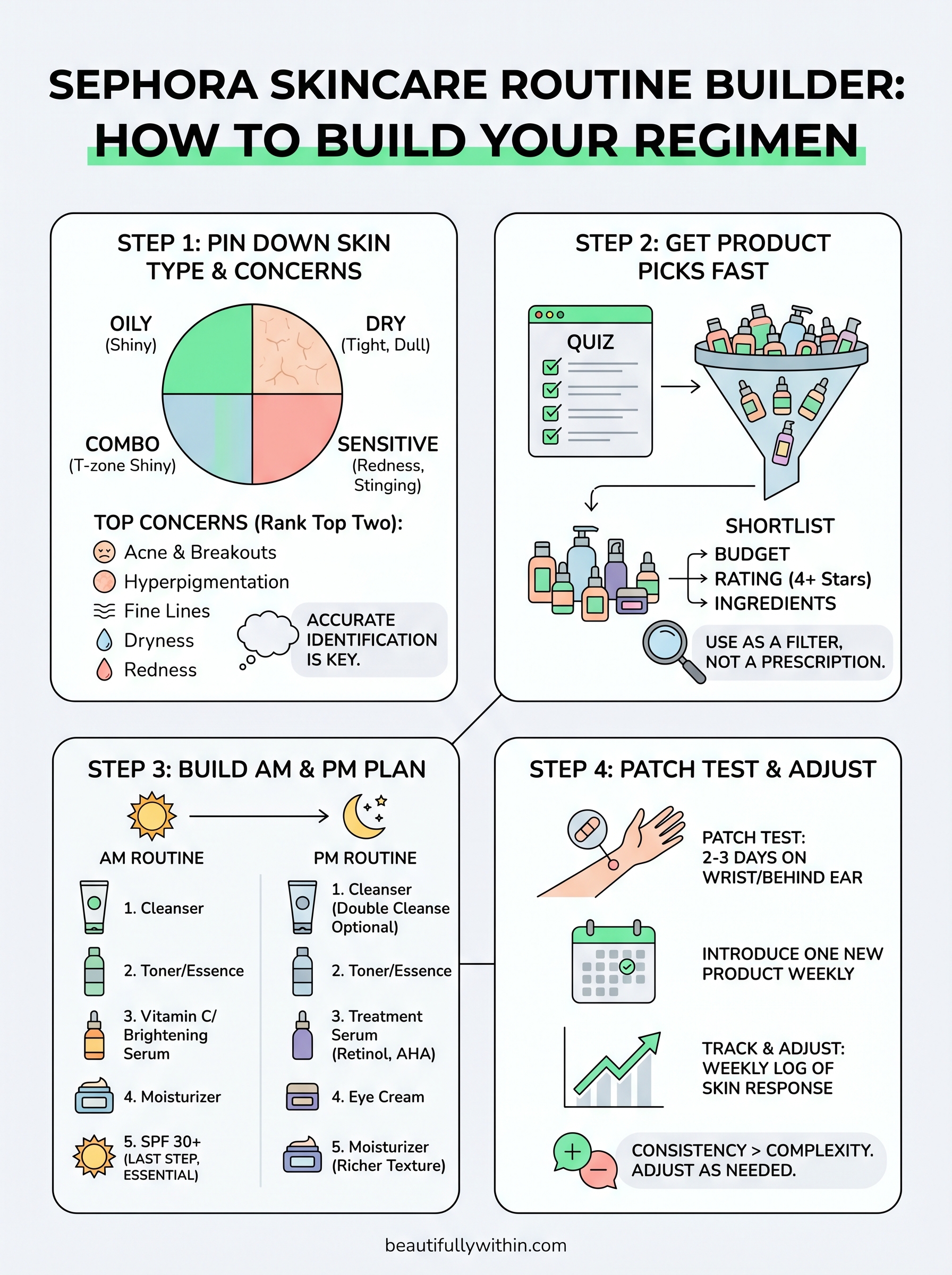
Before you touch the Sephora skincare routine builder, you need two things locked in: your skin type and your top one or two concerns. Skipping this step is the most common reason people end up with products that don't work. The quiz asks these questions upfront, and if your answers are vague or wrong, every recommendation that follows will be off.
Identify your skin type accurately
Your skin type is not permanent, but it's consistent enough day to day that you can work with it. The simplest way to check is the bare-face test: wash your face with a gentle cleanser, skip all products, and wait 60 minutes. Then look at your skin in natural light. If it looks shiny all over, you're oily. If it feels tight and looks dull, you're dry. If your T-zone (forehead, nose, chin) is shiny but your cheeks feel normal or tight, you're combination. If your skin reacts easily to products with redness, stinging, or flushing, mark it as sensitive regardless of oil levels.

Getting your skin type right at this stage saves you from cycling through products that address the wrong problem entirely.
Narrow your concerns to two
The builder lets you select multiple concerns, but the more you pile on, the less focused your routine becomes. Rank your top two concerns and lead with those. Use the table below to match common issues to the ingredient categories you should be filtering for:
| Concern | Key ingredients to look for |
|---|---|
| Acne and breakouts | Salicylic acid, niacinamide, benzoyl peroxide |
| Hyperpigmentation | Vitamin C, kojic acid, tranexamic acid |
| Fine lines and loss of firmness | Retinol, peptides, hyaluronic acid |
| Dryness and dehydration | Ceramides, hyaluronic acid, squalane |
| Redness and sensitivity | Centella asiatica, azelaic acid, oat extract |
Once you know your skin type and ingredient targets, you're set up to filter the builder's results with purpose rather than just scrolling through whatever it surfaces first.
Step 2. Use Sephora tools to get product picks fast
With your skin type and top concerns identified, you're ready to put the Sephora skincare routine builder to work. The goal here isn't to browse, it's to get a focused product shortlist as quickly as possible and then evaluate it critically. Treat this step as data collection, not a shopping session.
Run the quiz with intentional answers
Open the routine builder on Sephora's website and answer each question based on what you confirmed in Step 1. When the quiz asks about your primary concern, select only your top two, the ones you ranked highest. Resist the urge to check every box. Overloading the tool with concerns produces a broader, less targeted list that's harder to act on.
Answering fewer questions with more precision gives you a tighter, more useful set of recommendations every time.
After the quiz runs, you'll see a product list organized by routine step: cleanser, toner or essence, treatment serum, moisturizer, eye cream, and SPF. Don't evaluate every item on first pass. Instead, note the product names and move directly into filtering.
Filter results down to a working shortlist
Sephora's filter panel sits on the left side of any search or recommendation page. Use it immediately to narrow results by your budget range and customer rating, setting the minimum rating to 4 stars or higher. This removes newer products with limited reviews and helps surface options that real users have validated over time.
Once you've applied filters, look at each remaining product's ingredient highlights and top customer reviews. Pay specific attention to reviews from people who mention a skin type matching yours. A moisturizer with hundreds of five-star reviews from oily skin users may not translate well to a dry skin routine.
Use the table below to decide how many products to shortlist per routine step before moving to Step 3:
| Routine step | Shortlist target |
|---|---|
| Cleanser | 2 options |
| Treatment serum | 2 to 3 options |
| Moisturizer | 2 options |
| SPF | 1 to 2 options |
| Eye cream | 1 option |
Step 3. Turn product picks into an AM and PM plan
Your shortlist from Step 2 is a collection of individual products, not a working routine yet. To make it functional, you need to assign each product to either your morning or evening slot and sequence them in the correct application order. Product order matters because thinner formulas absorb faster and go on before thicker ones, and certain ingredients are strictly daytime or nighttime only. This is the step where the Sephora skincare routine builder's product list becomes something you can actually follow every day.
Build your AM routine
Your morning routine has one non-negotiable: SPF goes on last, always. Everything else builds toward that final protective layer. Keep your AM routine simple because fewer steps before your day starts means better consistency over time.
Use this template to slot your morning products in the right order:
| Step | Product type | Example ingredient focus |
|---|---|---|
| 1 | Cleanser | Gentle, low-pH formula |
| 2 | Toner or essence (optional) | Hydrating, alcohol-free |
| 3 | Vitamin C or brightening serum | Ascorbic acid, niacinamide |
| 4 | Moisturizer | Ceramides, hyaluronic acid |
| 5 | SPF 30 or higher | Broad-spectrum, every single day |
Applying SPF as the last step protects every layer beneath it and gives the sunscreen filters the surface contact they need to work correctly.
Build your PM routine
Your evening routine is where active ingredients like retinol, AHAs, and peptides belong. These work best overnight when your skin isn't facing UV exposure, and some, like retinol, break down in sunlight. Your PM routine can run slightly longer than your AM routine because you skip SPF and have more time between steps.
Use this template to build your evening sequence:
| Step | Product type | Example ingredient focus |
|---|---|---|
| 1 | Cleanser | Same as AM, or an oil cleanser first |
| 2 | Toner or essence (optional) | Hydrating or exfoliating |
| 3 | Treatment serum | Retinol, AHA, or peptides |
| 4 | Eye cream | Peptides, caffeine |
| 5 | Moisturizer | Richer texture than your AM formula if skin feels dry overnight |
Step 4. Patch test, introduce actives, and adjust weekly
You have your AM and PM routines mapped out from the Sephora skincare routine builder, but don't start running both full routines simultaneously. Introducing multiple new products at once makes it impossible to identify what caused a breakout or reaction. Instead, add one new product at a time and give your skin at least five to seven days to respond before adding the next.
How to patch test a new product
Before you apply anything new to your full face, patch test it for two to three days on a small area, such as the inside of your wrist or behind your ear. Apply the product once daily to that spot and watch for redness, itching, or swelling. If nothing happens after 48 to 72 hours, move it to a small area on your jaw or cheek for two more days before rolling it into your full routine.
Patch testing feels slow, but it saves you from a full-face reaction that sets your routine back by weeks.
Follow this order when introducing your shortlisted products into your routine:
- Start with your cleanser in week one, morning and evening
- Add your moisturizer in week two
- Introduce your SPF in the morning of week three
- Add your treatment serum in week four, starting with two nights per week before increasing frequency
Track your skin weekly and adjust
Your skin changes with seasons, stress, diet, and hormones, so a routine that works in week one may need adjustments by week four. Keep a simple weekly log where you note any dryness, breakouts, or texture changes after each new product introduction. A notes app on your phone works fine.
Check three specific things at the end of each week: whether your skin feels balanced after cleansing, whether any new texture or discoloration has appeared, and whether your current actives are causing sensitivity. If you notice persistent irritation from a specific product, drop it back to every other day rather than cutting it entirely, your skin may just need a slower adjustment period.
Conclusion
The Sephora skincare routine builder gives you a real head start, but the routine you end up with depends on how well you apply the steps covered in this guide. You now know how to identify your skin type accurately, filter product recommendations with real purpose, sequence your AM and PM steps correctly, and introduce new actives without overwhelming your skin.
Consistency matters more than having the perfect product lineup. A focused four-step routine you follow every single day will outperform a complex ten-step plan you abandon after two weeks. Adjust as your skin responds, keep your weekly log, and trust the process to show results over time.
When you're ready to expand your options beyond Sephora's catalog, browse our premium skincare collection for curated formulas across every routine step, including products designed for sensitive skin and visible results.
✨ Shop the Look at Beautifully Within
Loved this guide? Discover our hand-picked picks that pair perfectly with your routine:
- 👉 Fresh Start Hydrating Cleanser & Toner Duo — Skincare Set
- 👉 BIOAQUA Rice Brightening Skincare Collection — 6-Piece Ritual — Skincare Set
- 👉 CHANDO Brightening Skincare Trio — Toner, Serum & Cream — Skincare Set
- 👉 Ayurvedic Facial Cleansing & Mask Ritual Kit — Skincare Set
New customer? Get 15% off orders $50+ with code WITHIN15 — plus free shipping over $75.
0 comments