

Ever bought a hair product that promised moisture and softness, only to end up with limp, greasy strands, or hair that still felt like straw? The problem probably wasn't the product. It was a mismatch with your hair porosity, and you're not alone. Most people skip this step entirely, then wonder why nothing seems to work.
Hair porosity determines how your strands absorb and hold moisture. Once you know yours, choosing the right conditioners, oils, and treatments stops being guesswork. The good news? You don't need a salon visit or a microscope to figure it out. Learning how to test hair porosity at home takes just a glass of water and a few minutes.
At Beautifully Within, we believe that caring for your hair starts with understanding it. That's why we put this guide together, three simple water-based tests you can do right now, plus what your results actually mean for building a hair care routine that works.
What hair porosity is and why it matters
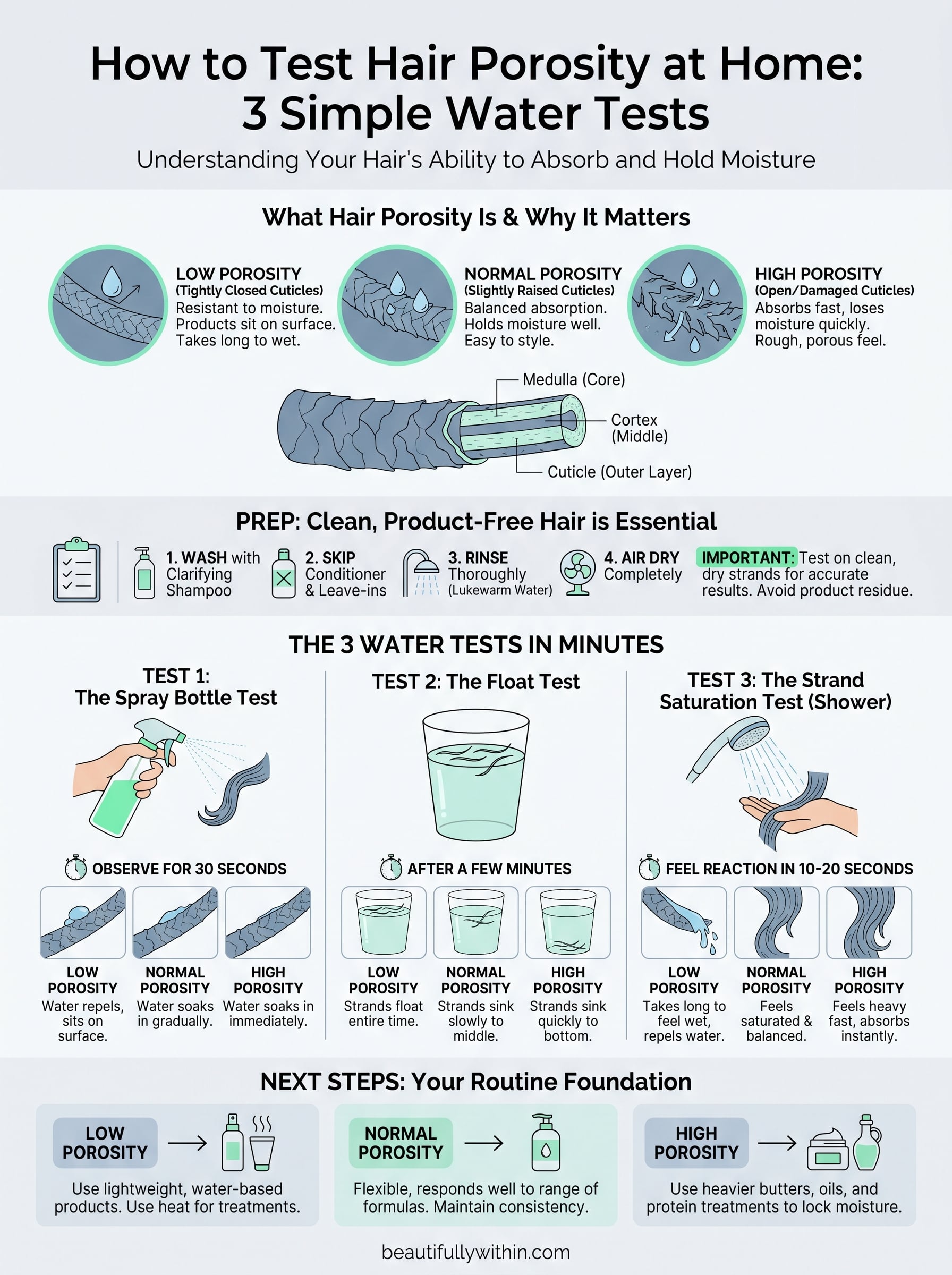
Hair porosity refers to how well your hair's cuticle, the outermost layer of each strand, opens up to absorb water and moisture, and how well it holds that moisture in. Think of the cuticle as a series of overlapping tiles on a roof. When those tiles lie flat and tight, moisture has a hard time getting in or out. When they sit raised or loose, water and products rush in quickly but escape just as fast.
The cuticle layer controls everything
Your hair strand has three layers: the medulla at the core, the cortex in the middle, and the cuticle on the outside. The cuticle is what you're essentially testing when you learn how to test hair porosity at home. Genetics set your baseline porosity level, but external damage can shift it significantly over time.
Common things that raise porosity:
- Bleaching or chemical coloring
- Frequent heat styling without protection
- Hard water mineral buildup
- Prolonged sun and UV exposure
The condition of your cuticle layer is the single biggest factor in how your hair responds to every product you put on it.
Low, normal, and high porosity: what each one means
Porosity falls into three categories, and each behaves differently when it meets water or product:
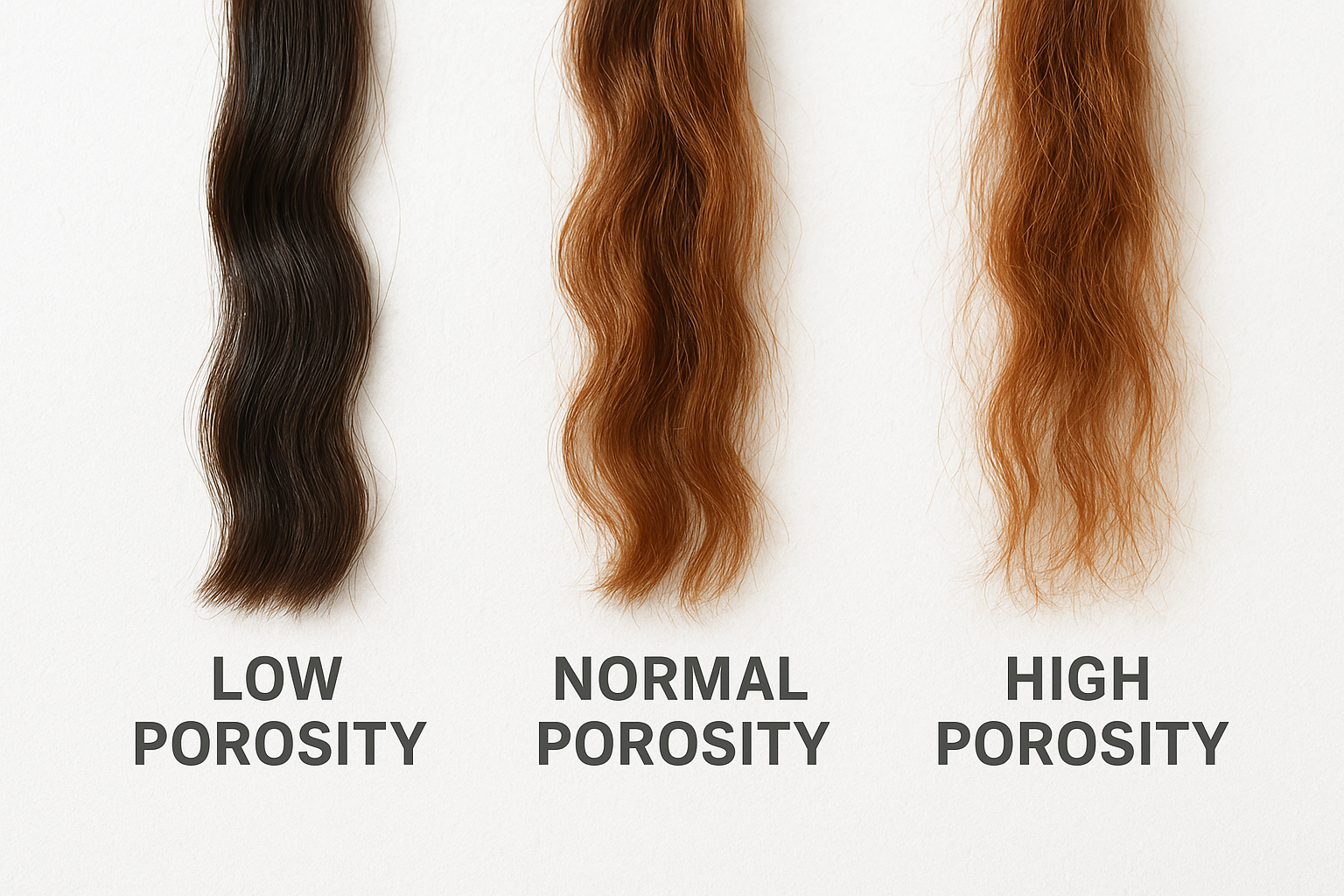
| Porosity Level | Cuticle State | How It Feels | Common Challenge |
|---|---|---|---|
| Low | Tightly closed | Smooth, resistant | Products sit on top; takes long to wet |
| Normal | Slightly raised | Balanced, soft | Holds moisture well; easy to style |
| High | Open or damaged | Rough, porous | Absorbs fast but loses moisture quickly |
Understanding which category you fall into removes the guesswork from every product decision you make going forward.
Why porosity changes how products work on your hair
Once you know your porosity level, product selection becomes straightforward rather than trial and error. Low-porosity hair needs lightweight, water-based products that won't sit on the surface and create buildup. High-porosity hair craves heavier butters, oils, and protein treatments that fill in cuticle gaps and slow moisture loss. Normal porosity hair is the most flexible and responds well to a wide range of formulas.
Skipping this step is exactly why a product that works for your friend does nothing for you. Your strands have their own rules, and knowing your porosity is how you learn them.
Before you test: set up clean, product-free hair
Before you run any of the three tests, your hair needs to be clean and completely free of product residue. Oils, leave-ins, dry shampoo, and styling creams all coat the strand and give you a false reading. If you test on product-coated hair, the results reflect what's sitting on top of your cuticle, not how your actual cuticle behaves.
Why a clean baseline matters
Product buildup acts like a physical barrier on your strand. A low-porosity result on dirty hair might actually be a layer of silicone or oil rather than tightly closed cuticles. Running any water test on freshly washed, unconditioned hair gives you an accurate picture of how your strands naturally interact with moisture.
Skip the conditioner entirely after washing. Even a small amount changes how water beads or absorbs on the strand.
Common products that skew test results include leave-in conditioners, hair oils, dry shampoo, and heat protectant sprays. Even something lightweight you use daily can coat the cuticle enough to throw off what you observe. Your cuticle's natural state is what you're measuring, not anything applied on top of it.
How to prep your hair before testing
Getting your hair ready takes one wash and a little drying time. Follow these steps in order:
- Wash with a clarifying or sulfate-based shampoo to remove oil and product buildup.
- Skip conditioner and all leave-in treatments after rinsing.
- Rinse thoroughly with lukewarm water and gently squeeze out the excess.
- Let your hair air dry completely before you begin.
If you want to learn how to test hair porosity at home accurately, this prep step is not optional. Starting with anything less than clean, dry hair means your results could point you toward the wrong routine entirely.
Test 1: the spray bottle test
The spray bottle test is the most straightforward method of the three, and it gives you a real-time look at how your hair responds to water. All you need is a small section of clean, dry hair and a spray bottle filled with plain water. This test works well because you can observe your strand's reaction immediately, without any waiting.
What you need
You only need a few basic items to run this test, and you likely already have all of them at home. Gather these before you start:
- A clean spray bottle filled with room-temperature water
- One small section of clean, air-dried hair (5 to 10 strands works fine)
- Good lighting so you can clearly see how the water behaves on the strand
How to run the test
Spray a light mist of water directly onto your selected hair section and watch closely for the first 30 seconds. The way the water behaves on your strand tells you immediately where your porosity falls.
Pay attention within the first 10 seconds specifically. That window gives you the clearest signal before external factors like air movement or humidity interfere.
Here is what to look for:
| What you observe | What it means |
|---|---|
| Water beads up and sits on the strand | Low porosity (cuticle is tightly closed) |
| Water absorbs within 10 to 30 seconds | Normal porosity (cuticle is balanced) |
| Water absorbs almost instantly | High porosity (cuticle is open or damaged) |
If you want to know how to test hair porosity at home without any special equipment, this test is your best starting point. Run it on two or three different sections from your roots, mid-lengths, and ends, since porosity can vary across the same head of hair.
Test 2: the float test
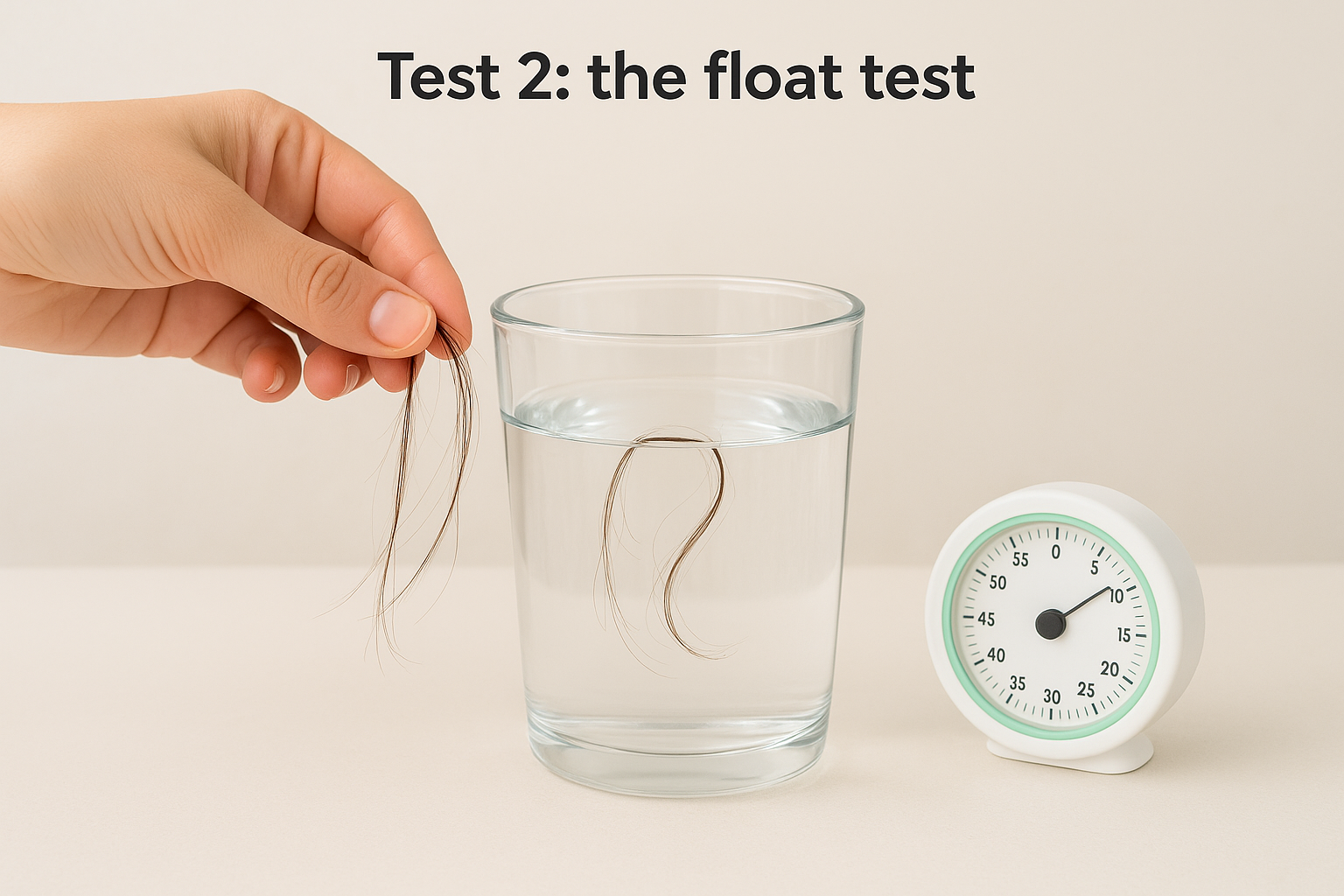
The float test is probably the most well-known method for testing hair porosity at home, and it requires nothing more than a clear glass of water and a few strands of hair. Unlike the spray bottle test, this one gives you a result you can observe over several minutes, which makes it useful for confirming what you saw in the first test.
What you need
Before you drop anything into the glass, make sure you have the right setup. Using room-temperature water matters here because hot or cold water can temporarily open or tighten your cuticle and skew the result.
- A clear glass or bowl filled with room-temperature water
- Two to three strands of clean, dry hair pulled directly from your head, not from a brush, since loose shed strands may behave differently
- A timer to track your observation window accurately
How to run the test
Place your strands gently on the surface of the water and watch without disturbing the glass for up to four minutes. Resist the urge to stir or prod. The strands will move on their own, and that movement tells you exactly where your porosity falls.
Pull strands from your roots, mid-lengths, and ends separately, since porosity can vary across the same head of hair.
| What you observe | What it means |
|---|---|
| Strands float the entire time | Low porosity (cuticle resists water) |
| Strands sink slowly to the middle | Normal porosity (balanced absorption) |
| Strands sink quickly to the bottom | High porosity (cuticle absorbs fast) |
Cross-check this result against your spray bottle test. Two matching readings give you a far more reliable picture of how your hair actually responds to moisture.
Test 3: the strand saturation test in the shower
The strand saturation test is the most hands-on of the three, and it works directly while you are washing your hair. This test focuses on how quickly your hair feels saturated when water hits it and how it behaves right after. It is especially useful because it replicates a real washing scenario, giving you a practical, in-context read on your porosity.
What you need
You do not need any special equipment here. Everything happens in your shower with clean hair and running water. Start this test at the beginning of your wash session before applying any shampoo, so your hair is dry and free of fresh product when the water first contacts it.
How to run the test
Step into the shower and direct a steady stream of water over one section of your hair. Keep the water at a consistent, lukewarm temperature and pay close attention to what happens during the first 10 to 20 seconds.
If water runs off the surface without soaking in after 20 seconds, you are almost certainly dealing with low-porosity hair.
Here is what each reaction tells you about how to test hair porosity at home using this method:
| What you observe | What it means |
|---|---|
| Water runs off and hair takes a long time to feel wet | Low porosity |
| Hair feels saturated within 10 to 15 seconds | Normal porosity |
| Hair soaks through almost instantly and feels heavy fast | High porosity |
After the water runs through, feel the weight and texture of the wet section. High-porosity hair feels noticeably heavier and may tangle quickly, while low-porosity hair stays relatively light and resistant even when fully wet.
Next steps for your routine
Now that you know how to test hair porosity at home using three different methods, the next move is putting those results to work. Cross-reference what you saw in at least two tests to confirm your porosity level, then let that single piece of information guide every product decision you make going forward. Your results are the foundation of a smarter, more effective routine.
If your hair came back low porosity, focus on lightweight, water-based formulas and use heat to help your cuticle open during treatments. High-porosity hair benefits most from heavy creams, butters, and protein-rich treatments that lock moisture in and slow down how fast your strands lose it. Normal porosity gives you the most flexibility, but staying consistent with your routine keeps it that way.
Ready to shop products matched to your actual hair needs? Browse the hair care collection at Beautifully Within to find treatments built for your porosity type.
✨ Shop the Look at Beautifully Within
Loved this guide? Discover our hand-picked picks that pair perfectly with your routine:
- 👉 32mm Ceramic Auto-Rotating Hair Curler — Hair Styling Tool
- 👉 5-in-1 Negative Ion Hot Air Styling Brush — Hair Styling Tool
- 👉 Ceramic Electric Hair Straightening Hot Comb — Hair Styling Tool
- 👉 Infrared Ionic Professional Hair Dryer — Hair Styling Tool
New customer? Get 15% off orders $50+ with code WITHIN15 — plus free shipping over $75.
1 comment
What is the name of the best treatment to use for high porosity hair