

You picked up a supplement bottle, flipped it around, and stared at a wall of numbers, percentages, and ingredient names you can't pronounce. You're not alone. Most people skip the label entirely or rely on whatever the front of the bottle promises. But knowing how to read supplement labels is one of the most practical skills you can build for your health, and it takes less effort than you think.
At Beautifully Within, we believe looking and feeling your best starts from the inside out. That includes being informed about what you're actually putting into your body, whether it's a collagen supplement, a daily multivitamin, or a wellness blend you found on our store.
This guide breaks down every section of a supplement label, from serving size and %Daily Value to ingredient lists and safety warnings. By the end, you'll know exactly what to look for, what to question, and how to make confident choices the next time you shop for supplements.
What supplement labels tell you and what they do not
Before you learn how to read supplement labels, it helps to understand exactly what kind of information a label is required to show you, and where its limits are. The FDA regulates dietary supplement labels under specific rules, which means every bottle must display certain standardized information. But those rules do not make every product equally safe or effective, and knowing that distinction changes how you approach the shelves.
What the label is required to show
The FDA requires supplement labels to include a Supplement Facts panel, which functions similarly to a Nutrition Facts panel on food. This panel must list the serving size, the number of servings per container, and every dietary ingredient in the product along with its quantity per serving. You will also find the manufacturer's name and address, a list of other ingredients such as fillers, binders, and flavorings, and any allergen warnings relevant to the formula.
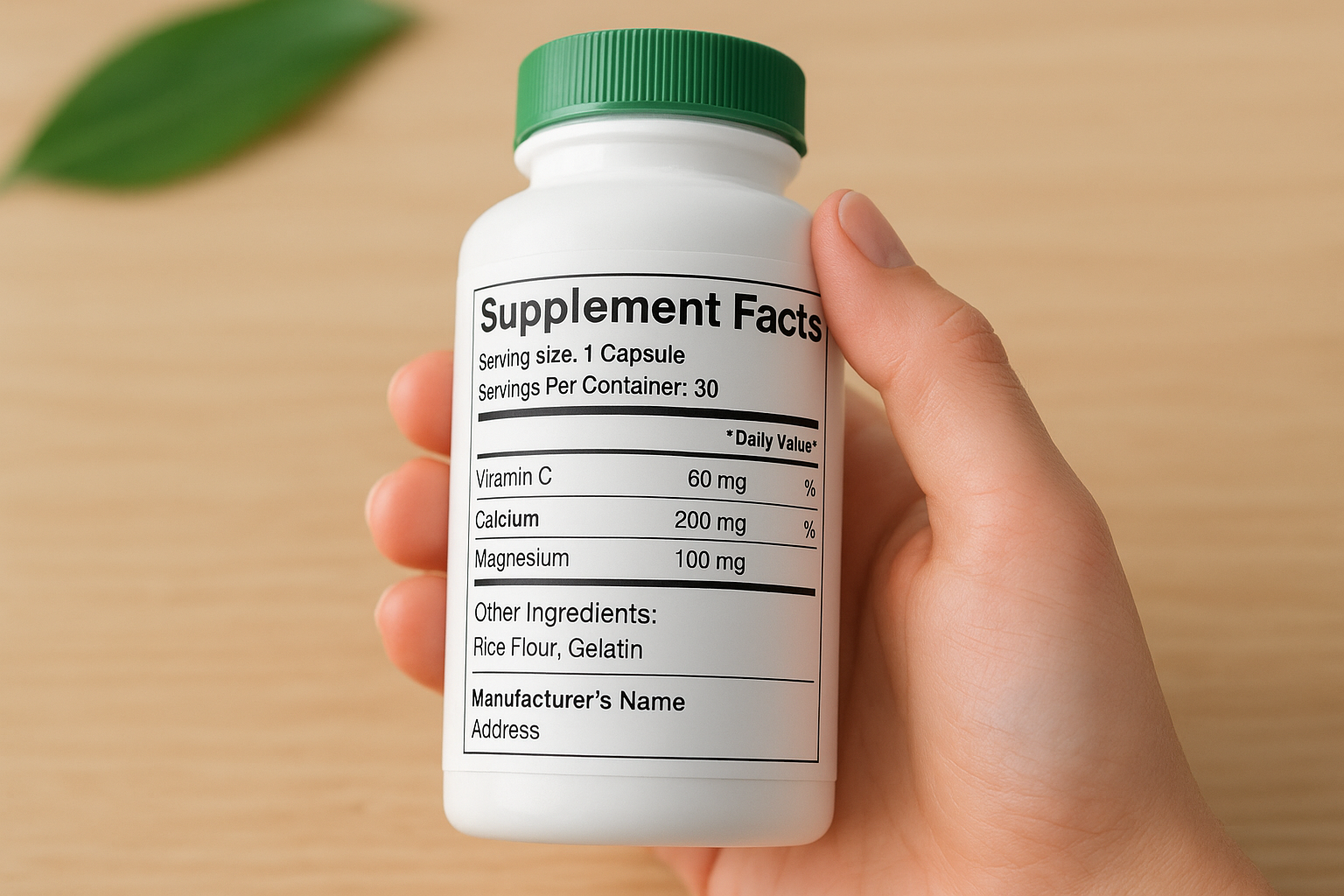
Knowing what the label must include gives you a clear baseline so you can immediately spot what's missing or suspiciously vague.
Here's a quick breakdown of the required elements you should expect on every supplement label:
- Serving size and servings per container
- Dietary ingredients with amounts per serving
- Percent Daily Value (%DV), when an established value exists
- Other ingredients, meaning the inactive components
- Manufacturer name and contact information
- Net quantity of contents
What the label does not guarantee
Here's where many people get tripped up. A supplement label does not mean the FDA has reviewed or verified that the product is safe, effective, or accurately dosed before it reaches store shelves. Unlike prescription drugs, supplements do not go through FDA approval before they go to market. The manufacturer takes responsibility for product safety, and the FDA only steps in after a problem gets reported.
Labels also do not tell you whether the dosage listed is clinically effective for your specific goal. A product might contain an ingredient backed by real research, but at a fraction of the dose used in those studies. You will not find that context on the bottle itself. That gap is exactly why reading the label is the starting point, not the full picture. Cross-referencing ingredients with resources like the NIH Office of Dietary Supplements gives you the evidence behind the numbers before you commit to a product.
Step 1. Start with serving size and servings
The serving size is the single most important number on the entire label, yet most people skip right past it. Every other number on the panel, every dose, every percentage, is calculated based on that one figure. If you miss it, every other number you read becomes meaningless. When you learn how to read supplement labels correctly, serving size is always your starting point.
Why serving size changes everything
Manufacturers set their own serving sizes, and those choices directly affect how impressive or understated the dosage numbers look. A serving size of three capsules means every ingredient listed is spread across three pills, not one. If you take only one capsule because you assumed that was a single dose, you are getting roughly a third of what the label advertises.
Always check whether the serving size matches what you actually plan to take before comparing products.
How to calculate your actual intake
Once you know the serving size, check the servings per container to understand how long the bottle will last. Multiply the serving size by the number of servings to confirm the total capsule or tablet count matches the label claim. Here's a simple template to run through with any bottle you pick up:
| Label Detail | What to Check |
|---|---|
| Serving size | How many capsules, tablets, or grams per dose |
| Servings per container | Total number of doses in the bottle |
| Total units | Serving size x servings per container |
| Cost per serving | Total price divided by servings per container |
Running through this table takes about thirty seconds and immediately tells you whether a product is a good value and whether the dose structure fits your routine.
Step 2. Read the active ingredients and amounts
Once you have the serving size locked in, move to the active ingredients list. This is where the product tells you what it's doing and in what quantities. When you know how to read supplement labels at this level, you stop buying based on front-label marketing language and start buying based on real, verifiable data.
Look at the ingredient form, not just the name
The same nutrient can appear in multiple forms, and the form matters significantly for absorption and effectiveness. Magnesium glycinate, for example, absorbs far better than magnesium oxide, even though both products might simply list "magnesium" at the same milligram count. Always check the form listed in parentheses next to the ingredient name, because that detail tells you whether you are getting a bioavailable version the body can actually use rather than one that passes through largely unabsorbed.
The ingredient form is often more important than the milligram amount listed next to it.
Watch for proprietary blends
Some manufacturers group multiple ingredients under a single proprietary blend, listing only the total weight of the combined blend rather than individual amounts. This approach makes it impossible to know whether each ingredient is present at a meaningful dose or just a token trace amount added for label appeal. Transparency here should matter to you, because a blend that sounds impressive could deliver sub-therapeutic amounts of every ingredient it contains.
Run through this checklist every time you review the active ingredients section:
- Confirm each ingredient shows an exact amount per serving, not just a blend total
- Check the ingredient form listed in parentheses
- Look up unfamiliar compounds on the NIH Office of Dietary Supplements to verify evidence and typical effective doses
- Flag any proprietary blends and weigh whether the overall product still meets your standard for transparency
Step 3. Use percent daily value correctly
The %Daily Value (%DV) column appears on most supplement labels, but it gets misread constantly. This percentage tells you how much of a specific nutrient one serving contributes toward the daily intake recommended for a general adult diet based on 2,000 calories per day. Understanding what that number actually reflects prevents you from over-supplementing or dismissing a product that genuinely fills a gap in your nutrition.
What %DV actually means
%DV is a reference tool, not a personal prescription. A supplement showing 100% DV for vitamin D delivers the FDA's daily reference amount, which currently sits at 800 IU for most adults. That figure does not mean 100% is the ideal dose for you specifically. Your healthcare provider might recommend more based on bloodwork, while someone else may need far less.
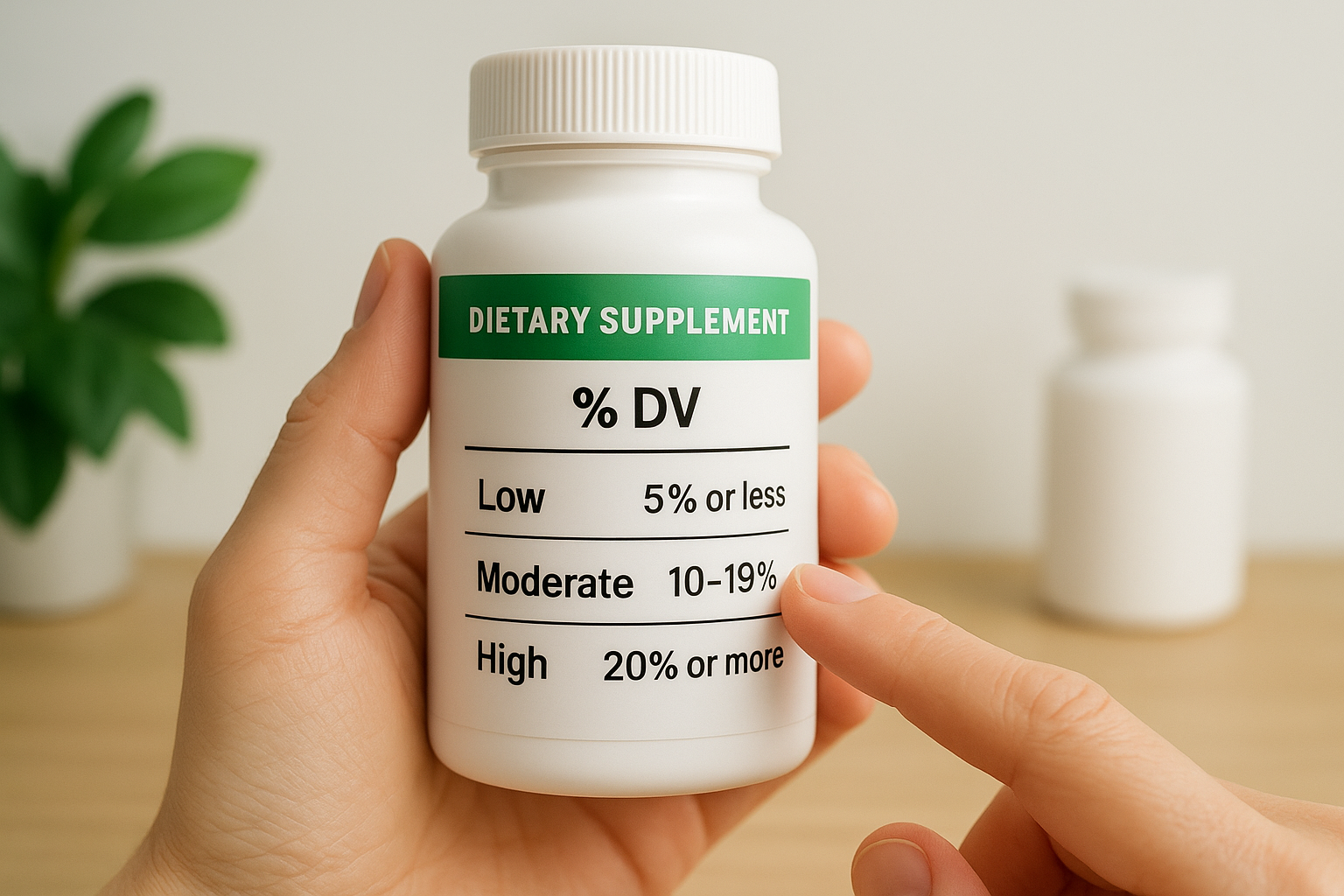
Use %DV as a quick comparison tool across products, not as a personal dosage recommendation.
Here's how to interpret %DV at a glance:
| %DV Range | What It Signals |
|---|---|
| 5% or less | Low contribution to daily intake |
| 10-19% | Moderate contribution |
| 20% or more | High contribution |
| Over 100% | Exceeds the standard daily reference value |
When %DV is missing or irrelevant
Not every ingredient carries an established %DV. Many herbal extracts, amino acids, and specialty compounds like ashwagandha or lion's mane have no FDA-set daily value, so their column will simply show "†" with a footnote stating "Daily Value not established." That absence does not mean the ingredient is unsafe or ineffective. Part of knowing how to read supplement labels is recognizing that a missing %DV is a signal to research that ingredient's effective range independently through a credible source like the NIH Office of Dietary Supplements.
Step 4. Check safety, claims, and quality signals
The final step in knowing how to read supplement labels is checking what the label says beyond the Supplement Facts panel. The front and back of a bottle carry health claims, certifications, and warnings that tell you a lot about how a product was made and marketed. Reading these signals critically protects you from products that look credible but fall short on safety or transparency.
Decode front-label health claims
The FDA allows three types of claims on supplement labels: nutrient content claims, health claims, and structure/function claims. Structure/function claims are the most common, and you recognize them immediately because they say things like "supports immune health" or "promotes healthy joints." These claims do not require FDA approval before the product ships, which means the manufacturer needs only to have some basis for making the claim and must include a disclaimer that the FDA has not evaluated it. That disclaimer is required by law and should appear on every product making such a statement.
If a label claim sounds like a medical promise rather than a general wellness statement, that is a red flag worth investigating before you buy.
Look for third-party testing
Third-party certification is one of the strongest quality signals on any supplement label. Organizations like USP, NSF International, and Informed Sport test products independently to verify that the label accurately reflects what is inside the bottle and that the product is free of harmful contaminants. Look for their seals on the label. If a product carries no third-party certification, that does not automatically make it unsafe, but it does mean you are relying entirely on the manufacturer's own quality control. Check the label also for allergen warnings and any cautionary statements about interactions with medications, which signal that the company is being upfront about its product.
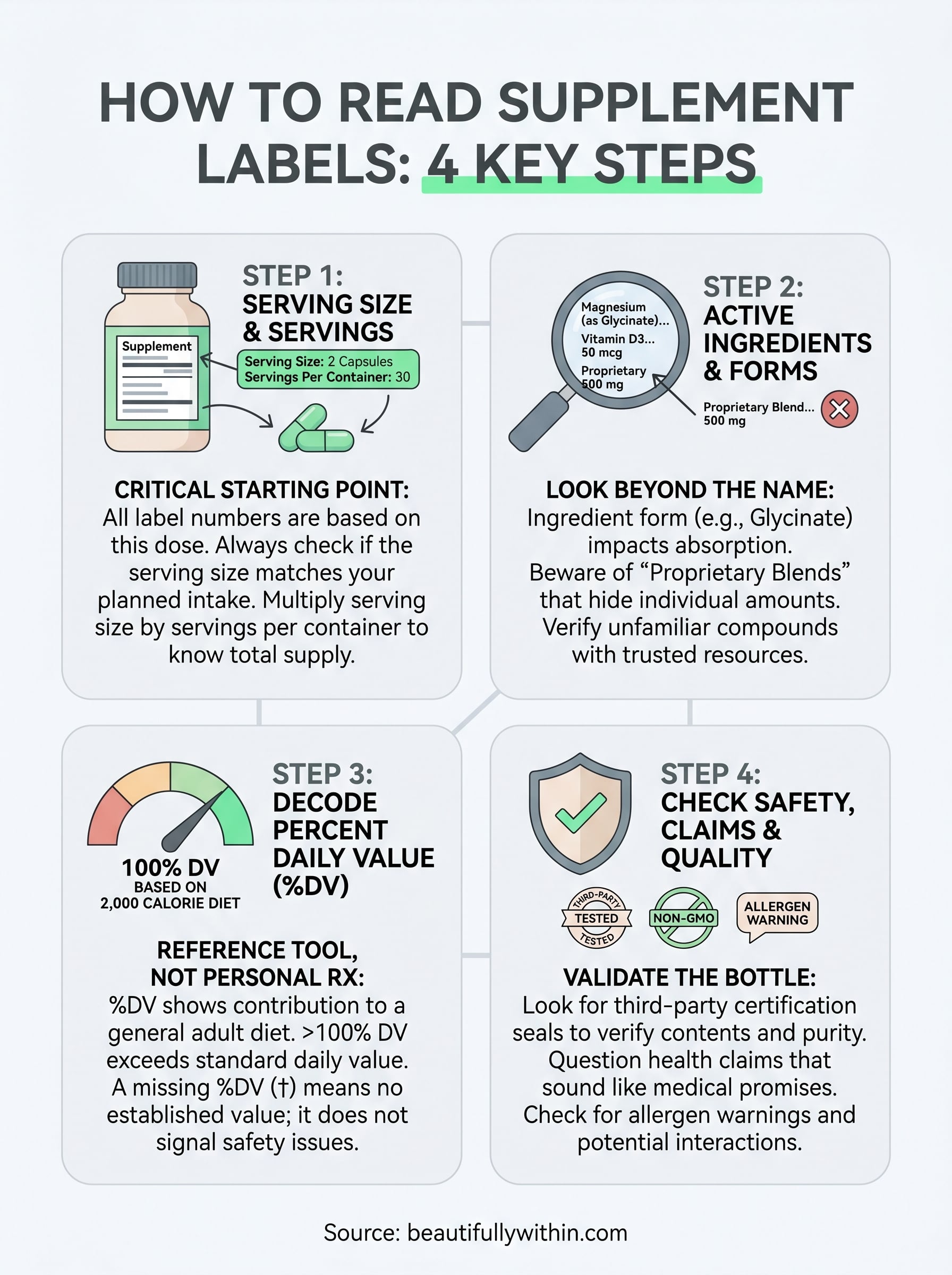
Make the label work for you
Knowing how to read supplement labels turns a confusing wall of text into a clear decision-making tool. Start with serving size, confirm the active ingredient forms, interpret %DV as a reference rather than a personal prescription, and check for third-party certifications before you buy. Those four steps give you a repeatable process you can apply in under two minutes with any product you pick up.
Your health goals deserve more than front-label promises. Every informed purchase you make using these skills is one you make with confidence rather than guesswork. Supplements that genuinely support your skin, hair, and overall wellness deliver better results when you choose them based on ingredient quality and transparent labeling, not just marketing language printed on the front of the bottle.
Ready to shop with that confidence? Browse our wellness supplements and find high-performance options designed to support your beauty from within.
0 comments