

You bought the vitamins, you read the labels, and you're ready to commit to a routine. But then a simple question stops you: when to take supplements morning or night? It's a fair question, and the answer actually matters more than most people realize. Timing affects how well your body absorbs certain nutrients and whether they help or hinder your sleep, energy, and digestion.
At Beautifully Within, we believe looking and feeling your best starts from the inside out, and that includes giving your body what it needs at the right time. Supplements play a real role in supporting your skin, hair, energy levels, and overall wellness, but only if you're taking them effectively.
This guide breaks down 9 practical tips to help you figure out the best time of day for your specific supplements. Whether you're dealing with an iron pill that wrecks your stomach or a magnesium capsule that makes you drowsy, you'll walk away knowing exactly when to take what, and why.
1. Pick supplements you will actually take consistently
Before you stress over whether to take your vitamin D in the morning or at night, ask yourself a more basic question: are you actually taking it? Consistency matters more than perfect timing when it comes to most supplements. A vitamin you take at 9 p.m. every day delivers far better results than one you take at the "ideal time" only twice a week.
Best timing
The best time to take any supplement is whenever you will reliably remember to take it. For most people, that means anchoring it to an existing daily habit, like making coffee, eating breakfast, or brushing your teeth. If you are still working out when to take supplements morning or night, start by identifying which part of your day stays the most predictable, regardless of what else is happening around you.
Best way to take it
Build a simple, repeatable system around your current routine rather than creating a new one from scratch. Keep your supplements somewhere visible, like next to your coffee maker or on your nightstand, so they are hard to overlook. A weekly pill organizer can also help you track whether you actually took each dose without having to rely on your memory at the end of a long day.
The most effective supplement routine is the one you actually stick to, not the one that looks perfect on paper.
Who should prioritize it
This tip applies to anyone starting or restarting a supplement routine. If you have a history of buying supplements and letting them sit half-finished in a cabinet, focus on building consistency before you worry about fine-tuning the timing. It is also especially useful if you take several different supplements and feel overwhelmed trying to manage them all at once.
Pitfalls to avoid
Do not skip a dose just because you missed your usual window. Missing a single dose rarely affects your long-term results, but skipping regularly does add up over time. Also avoid storing supplements in places that are inconvenient or out of sight, like a drawer you rarely open. If your supplements are not in plain view during your daily routine, you will forget them far more often than you expect.
2. Take water-soluble vitamins earlier with water
Water-soluble vitamins, including vitamin C and the entire B vitamin family, work differently than fat-soluble ones. Your body absorbs what it needs and flushes out the excess through urine, which means you get the most from them by taking them consistently and at the right time of day.
Best timing
Morning is the ideal window for most water-soluble vitamins. B vitamins in particular support energy metabolism and nervous system function, so taking them early aligns with your body's natural activity cycle. If you are still sorting out when to take supplements morning or night, water-soluble vitamins are one of the clearest answers: earlier is better.
Taking B vitamins too late in the day is one of the most common reasons people report trouble falling asleep after starting a new supplement routine.
Best way to take it
Take water-soluble vitamins with a full glass of water, ideally alongside or just after a light meal or snack. This helps with absorption and reduces any mild stomach irritation that some people notice with higher doses of vitamin C.
Who should prioritize it
Anyone taking B12, B6, or vitamin C should pay attention to morning timing. These are especially relevant if you follow a plant-based diet, feel consistently low on energy, or are actively supporting skin health and immune function.
Pitfalls to avoid
Avoid taking high-dose B vitamins right before bed. The energy-boosting effect can interfere with your ability to wind down, even if you do not feel obviously stimulated.
3. Take fat-soluble vitamins with a meal that has fat
Fat-soluble vitamins, including vitamins A, D, E, and K, need dietary fat to absorb properly. Your body stores them in fat tissue and the liver rather than flushing out excess like water-soluble vitamins, which means taking them without fat nearby significantly reduces how much your body actually uses.

Best timing
When thinking about when to take supplements morning or night, fat-soluble vitamins give you real flexibility since timing matters less than what you eat alongside them. Take them with whichever meal contains the most fat in your day, whether that is breakfast, lunch, or dinner.
Best way to take it
Pair fat-soluble vitamins with a food that naturally contains fat, such as eggs, avocado, nuts, olive oil, or full-fat dairy. You do not need a heavy meal. Even a small amount of dietary fat is enough to activate the absorption process in your digestive tract.
Skipping fat at the same meal as your vitamin D or vitamin K2 can cut absorption significantly, even if you take your supplement every single day.
Who should prioritize it
People supplementing with vitamin D or vitamin K2 should be especially consistent about pairing with fat. Those who follow low-fat diets or regularly skip meals are at the highest risk of poor absorption despite taking their supplement daily.
Pitfalls to avoid
Do not take fat-soluble vitamins with a fat-free meal or on an empty stomach. Taking vitamin D with only juice or black coffee, for example, is one of the most common reasons blood levels stay low despite months of consistent supplementation.
4. Keep energizing supplements away from bedtime
Energizing supplements can interfere with your sleep in ways you may not immediately connect to your supplement routine. If you are still working out when to take supplements morning or night, stimulating ones are among the easiest to place: keep them well before the evening hours.
Best timing
Take energizing supplements, including B vitamins, iron, CoQ10, and ginseng, before noon whenever possible. Your body processes these most usefully during active hours, and the stimulating effect tends to linger for several hours after you take them.
Best way to take it
Pair energizing supplements with your morning meal or a mid-morning snack to spread the effect across your most productive part of the day. This timing also supports better digestion for supplements like iron, which can cause discomfort on an empty stomach.
Taking CoQ10 or B vitamins after 3 p.m. is one of the most overlooked reasons people struggle to fall asleep even when they feel physically tired.
Who should prioritize it
Anyone managing fatigue, low energy, or persistent brain fog should be especially mindful of this rule. Athletes supplementing with CoQ10 or iron to support performance also benefit from morning scheduling so the boost aligns with their training window rather than their wind-down routine.
Pitfalls to avoid
Avoid taking iron or CoQ10 close to bedtime even when your schedule gets disrupted. Skipping a single dose entirely is a better option than taking an energizing supplement at 10 p.m. and spending the next two hours unable to fall asleep.
5. Use evenings for supplements that feel more calming
Some supplements work with your body's natural wind-down process rather than against it. Magnesium, melatonin, and ashwagandha are commonly associated with relaxation, reduced stress responses, and better sleep quality, which makes them a natural fit for the evening hours.
Best timing
Evening timing, roughly one to two hours before bed, works best for calming supplements. If you are still sorting out when to take supplements morning or night, this category is one of the most straightforward to place. Magnesium glycinate and L-theanine, for example, are best taken in the final stretch of your day when you want to shift into a quieter, lower-stimulation state.
Best way to take it
Take calming supplements with a small snack or a glass of water to ease digestion and help your body absorb them smoothly. Avoid combining them with caffeine or any stimulating supplements at the same time, since that directly cancels out their intended effect.
Magnesium glycinate taken consistently before bed is one of the most well-supported strategies for improving both sleep quality and overnight muscle recovery.
Who should prioritize it
Anyone dealing with stress, muscle tension, or disrupted sleep will get the most from evening supplementation. People with high-intensity training schedules also benefit from nighttime magnesium since it actively supports muscle repair while you sleep.
Pitfalls to avoid
Avoid taking melatonin too early in the evening or at wildly inconsistent times each night. Using it before your body is naturally ready to sleep can leave you feeling groggy the next morning rather than rested.
6. Separate minerals that compete for absorption
Some minerals actively block each other when taken at the same time. Calcium and iron, for example, compete for the same absorption pathways in your digestive tract, meaning taking them together significantly reduces how much of either mineral your body actually gets. When figuring out when to take supplements morning or night, spacing out competing minerals is one of the most impactful adjustments you can make.

Best timing
Iron works best taken in the morning on an empty stomach or at least two hours away from any calcium supplement. Space zinc and copper similarly, since they compete for the same transporter proteins. A general rule: give competing minerals at least two hours apart.
Separating calcium and iron by just a few hours can meaningfully improve your iron absorption, which matters most if you are managing low ferritin or anemia.
Best way to take it
Take iron with vitamin C to boost absorption, and keep it away from calcium-rich foods like dairy as well as calcium supplements. Calcium absorbs better when split across two smaller doses during the day rather than taken all at once, which also improves its uptake independent of the competition issue.
Who should prioritize it
Anyone taking both iron and calcium needs to pay attention here. Women who supplement with multiple minerals for bone health, energy, or hormonal support will benefit most from a scheduled, spaced-out approach.
Pitfalls to avoid
Avoid stacking several mineral supplements into a single meal thinking it saves time. Splitting them across the day takes minimal extra effort but delivers noticeably better results over time.
7. Plan around coffee, tea, and an empty stomach
Coffee and tea contain tannins and polyphenols that directly interfere with how your body absorbs certain minerals. This is one of the more overlooked factors when figuring out when to take supplements morning or night, especially if you start your day with a hot beverage before anything else.
Best timing
Wait at least 30 to 60 minutes after your morning coffee or tea before taking minerals like iron, zinc, or magnesium. If you drink caffeine throughout the day, build your supplement schedule around the longest gap between cups so absorption is not repeatedly blocked.
Taking iron within an hour of your morning coffee can reduce its absorption by up to 80%, even if you are taking a high-quality supplement every single day.
Best way to take it
Take most supplements with plain water rather than coffee, tea, or juice unless a specific supplement calls for food or fat. If your stomach is sensitive on an empty stomach, a small bite of food before swallowing your supplement reduces irritation without blocking absorption the way a full meal might.
Who should prioritize it
Heavy coffee drinkers and daily tea drinkers need to be especially careful with mineral supplements. Anyone who relies on caffeine first thing in the morning will benefit most from spacing supplements away from that window so the tannins do not undercut absorption quietly over time.
Pitfalls to avoid
Avoid washing down iron or zinc with coffee, tea, or calcium-fortified juice. Each of these competes with or blocks mineral absorption in its own way, and combining them with your supplements is an easy mistake that reduces results without any obvious warning sign.
8. Reduce nausea and stomach upset without losing results
Some supplements are notorious for causing stomach issues, including iron, zinc, and fish oil. The good news is that nausea and upset stomach are almost always a timing or pairing problem, not a sign that the supplement is wrong for you. Adjusting when and how you take it is usually all it takes to eliminate the discomfort without sacrificing any of the benefits.
Best timing
Taking stomach-sensitive supplements with food rather than on an empty stomach solves most nausea problems without reducing effectiveness. This is one of the most practical answers to the question of when to take supplements morning or night: simply choose the time of day when you have a solid meal ready to pair with it.
Best way to take it
Pair iron and zinc with a small but complete meal rather than just a plain cracker. Fish oil capsules taken mid-meal instead of right before or after significantly reduce the fishy aftertaste and queasiness that many people experience with higher doses.
Splitting a high iron dose into two smaller doses taken with separate meals is often more effective than one large dose, both for absorption and for reducing stomach discomfort.
Who should prioritize it
Anyone who has quit a supplement because it made them feel sick should try this timing fix before giving up entirely. People with sensitive stomachs or acid reflux typically tolerate supplements much better once they pair them consistently with food rather than taking them at an inconvenient, rushed moment.
Pitfalls to avoid
Avoid taking iron or high-dose zinc on an empty stomach even when your schedule gets disrupted. Pushing through repeated nausea rarely leads to better results and is one of the most common reasons people abandon their supplement routine before seeing any real benefit.
9. Watch for medication and condition timing conflicts
Certain supplements interact directly with prescription medications or work against specific health conditions when taken at the wrong time. This is the most critical variable to consider when deciding when to take supplements morning or night, and it is also the one most people overlook until something goes wrong.
Best timing
Thyroid medications like levothyroxine need to be taken on an empty stomach, typically first thing in the morning, and kept away from calcium, iron, and magnesium by at least four hours. If you take blood thinners like warfarin, vitamin K intake timing becomes medically significant and should be discussed with your doctor directly.
Talking with your prescribing physician before adding any new supplement to a medication routine can prevent dangerous interactions that no timing guide alone can fully address.
Best way to take it
Keep a simple written list of your medications and supplements alongside the times you take them. Sharing this list with your pharmacist or doctor gives them the clearest picture of potential conflicts and helps you build a schedule that is both safe and effective.
Who should prioritize it
Anyone taking prescription medications, managing a thyroid condition, or dealing with a cardiovascular diagnosis needs to treat timing as a medical issue, not just a convenience one. Pregnant women and older adults managing multiple prescriptions should be especially careful here.
Pitfalls to avoid
Never assume that natural or over-the-counter supplements are automatically safe to combine with medications. St. John's Wort and fish oil, for example, both have documented interactions with common prescriptions that can reduce their effectiveness or increase unwanted side effects.
A quick wrap-up
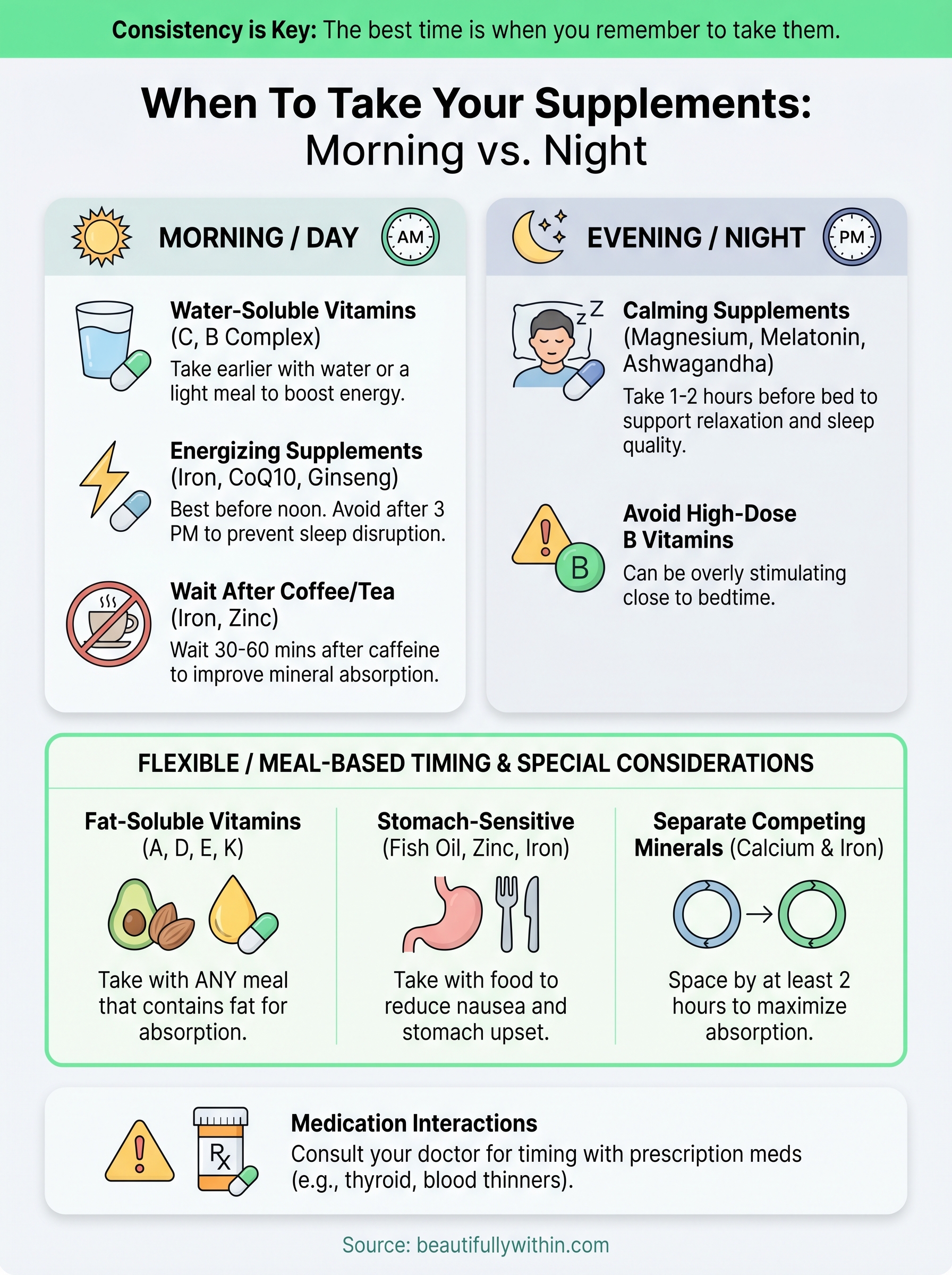
Figuring out when to take supplements morning or night comes down to understanding how each nutrient behaves in your body. Water-soluble vitamins work best early, fat-soluble vitamins need fat to absorb, energizing supplements stay away from bedtime, and calming ones belong in your evening routine. Minerals that compete need space between them, and anything that upsets your stomach almost always improves with food.
None of these tips require a complicated system. A simple, consistent routine built around your existing daily habits will get you further than a perfect schedule you cannot maintain. Start with the changes that address your biggest current problem, whether that is poor absorption, stomach upset, or disrupted sleep, and build from there.
Your supplements work best when your whole wellness routine supports them. If you are ready to take that next step, explore our health and wellness collection to find supplements that fit your goals.
0 comments