

Deep conditioning isn't just a nice-to-have, it's the difference between hair that looks tired and hair that actually feels alive. If you've been wondering how to deep condition hair at home, you're already asking the right question. Whether your strands are fried from heat styling, dried out from color treatments, or just naturally thirsty, a good deep conditioning session can bring back softness, shine, and strength without a salon visit.
I've been there myself. After going blonde a few years back, my naturally thick, wavy hair turned into a frizzy mess. I tried product after product until I figured out what actually worked, and more importantly, what my hair type needed. That trial-and-error process is a big part of why we built Beautifully Within: to help you skip the guesswork and find what works for your hair, your skin, and your overall confidence. Because looking and feeling your best really does start from the inside out.
In this guide, you'll get a clear, step-by-step walkthrough of how to deep condition at home, including DIY mask recipes using natural ingredients, professional application techniques, how often to do it, and targeted tips for specific concerns like dryness and damage. Let's get into it.
What deep conditioning is and when to do it
Deep conditioning is a treatment that goes further than your regular rinse-out conditioner. Regular conditioner sits on the surface of the hair shaft and does a light job of detangling and adding surface softness. A deep conditioner, by contrast, uses heavier ingredients like proteins, butters, and oils to penetrate the cortex of the hair and rebuild its structure from the inside out. The result is softer, stronger strands that hold up better against heat, color, and everyday stress.
How it differs from regular conditioner
The biggest difference comes down to contact time and ingredient concentration. Regular conditioner works in about two to three minutes and rinses clean. A deep conditioner needs at least 15 to 30 minutes to do its job, and its formula is far richer, often containing humectants like glycerin, emollients like shea butter, and proteins like keratin or hydrolyzed wheat. Your hair has real time to absorb those ingredients, which is why the results feel noticeably different after just one session.
| Regular Conditioner | Deep Conditioner | |
|---|---|---|
| Contact time | 2-3 minutes | 15-45 minutes |
| Primary purpose | Detangle, surface softness | Repair, strengthen, deep moisture |
| Key ingredients | Silicones, light oils | Proteins, butters, humectants |
| Frequency | Every wash | 1-2x per week or as needed |
Signs your hair needs a deep condition
Your hair gives you clear signals when it's running low on moisture or strength. Excessive frizz, snapping when you detangle, rough texture even after washing, and a dull, lifeless look are all signs you need to go deeper than your daily routine. If you're researching how to deep condition hair at home, your strands are likely already sending that message.
The more damage your hair has taken from heat, color, or chemical treatments, the more often a dedicated deep conditioning session will move the needle.
For most hair types, once a week is a solid starting point. Fine hair can stretch to every two weeks without overloading the strands, while very dry, coarse, or chemically treated hair may benefit from twice a week until moisture levels stabilize.
Step 1. Choose a formula for your hair needs
The single biggest mistake people make when learning how to deep condition hair at home is reaching for the first product they see. Your hair type and its current condition should drive every formula decision you make. A thick, dry or coarse strand needs something completely different from fine, color-treated hair that's prone to buildup.
Moisture vs. protein: pick the right one first
Deep conditioners fall into two main camps: moisture-based and protein-based. Moisture formulas use humectants and emollients like shea butter, aloe vera, and honey to restore softness and flexibility. Protein formulas use ingredients like keratin, silk amino acids, or hydrolyzed wheat protein to rebuild and reinforce damaged strands. Using the wrong one can backfire: too much protein on already brittle hair makes it snap, and too much moisture on low-porosity hair leaves it limp and weighed down.
If your hair stretches and then breaks, you need protein. If it snaps immediately with no stretch at all, you need moisture.
Quick formula guide by hair type
Once you identify your hair's main need, matching it to the right formula gets straightforward. Fine or low-porosity hair does best with lightweight, protein-rich formulas that won't weigh strands down. Thick, coarse, or high-porosity hair responds well to rich, butter-heavy moisture treatments. Color-treated or heat-damaged hair often needs both, so look for a balanced formula that lists a protein and an emollient within the first five ingredients.
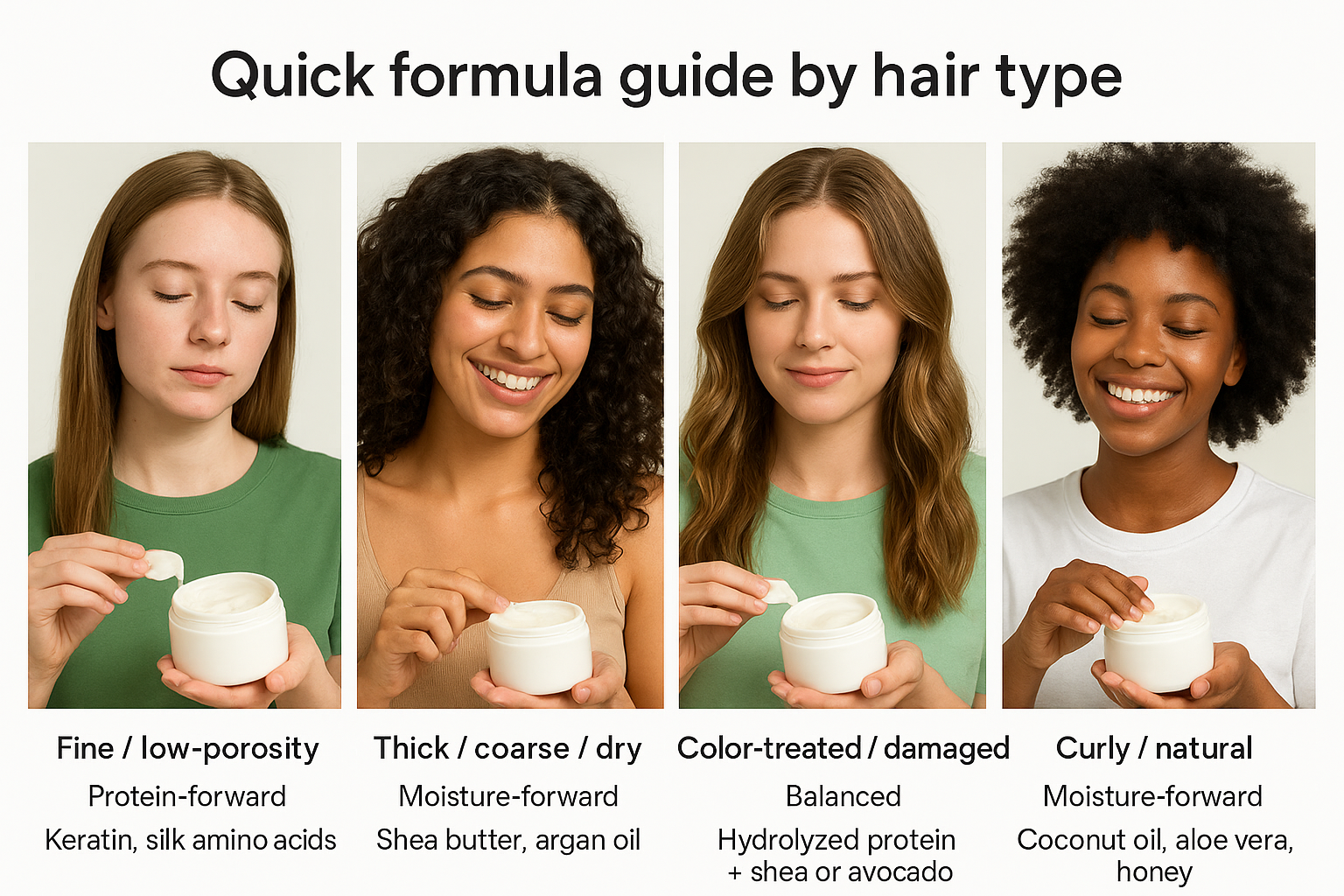
| Hair Type | Formula Focus | Key Ingredients to Look For |
|---|---|---|
| Fine / low-porosity | Protein-forward | Keratin, silk amino acids |
| Thick / coarse / dry | Moisture-forward | Shea butter, argan oil |
| Color-treated / damaged | Balanced | Hydrolyzed protein + shea or avocado |
| Curly / natural | Moisture-forward | Coconut oil, aloe vera, honey |
Step 2. Apply it like a pro
Picking the right formula is only half the work. How you apply a deep conditioner determines whether those ingredients actually reach the parts of your hair that need them most. Sloppy application wastes the product and leaves you with uneven results, so it's worth slowing down and doing this part intentionally.
Start with clean, damp hair
Before you apply anything, make sure your hair is freshly shampooed and lightly towel-dried. Damp hair absorbs deep conditioners far better than dry hair because the cuticle is already slightly open and ready to take in moisture. If you apply a mask to dry, unwashed hair, you're essentially layering product on top of buildup and old sebum, which blocks absorption right from the start.
Damp, not soaking wet, is the sweet spot. Excess water dilutes the formula and reduces how much your strands can actually absorb.
Section and saturate from mid-length to ends
Divide your hair into four sections using clips, then work through each one systematically. Apply your deep conditioner starting at the mid-lengths and ends, which is where the most damage and dryness accumulate. Your roots get natural oils from your scalp, so you rarely need to load conditioner there unless your scalp is extremely dry. Use your fingers or a wide-tooth comb to distribute the product evenly and make sure every strand is coated.
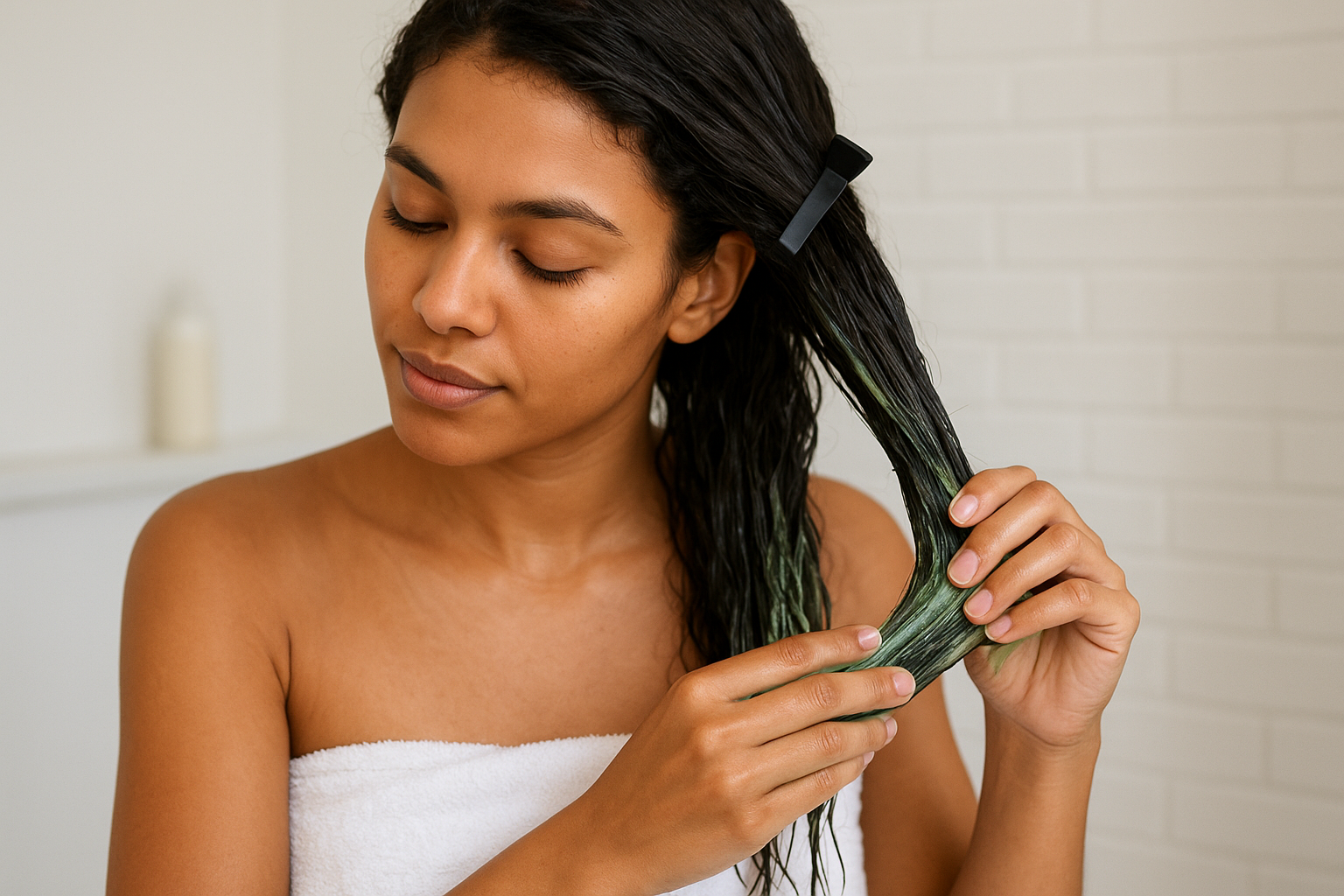
Follow this simple application sequence for the best results when learning how to deep condition hair at home:
- Shampoo and towel-dry until damp
- Divide into four sections
- Apply product from mid-shaft to ends on each section
- Use a wide-tooth comb to distribute evenly
- Pile hair on top of your head or use a shower cap
Step 3. Use time, heat, and rinsing to lock it in
Once your deep conditioner is applied, how you handle the next 15 to 45 minutes makes the real difference. Time, a little heat, and the way you rinse all work together to determine how much of that formula your hair actually holds onto. Skipping any one of these steps cuts your results short.
Let time do the heavy lifting
Most people rinse too early. A minimum of 15 minutes is the baseline for any deep conditioner, but for dry, damaged, or very thick hair, 30 to 45 minutes gives the ingredients more time to work through the cortex. Set a timer after you apply and resist the urge to rush it. The longer your strands sit with the treatment, the more moisture and protein they can absorb.
If you only have 15 minutes, you'll still see results, but giving your hair 30 minutes consistently will produce noticeably better softness and strength over time.
Add heat to boost absorption
Gentle heat opens the hair cuticle slightly, which lets your deep conditioner penetrate deeper. You can use a hooded dryer on a low setting, wrap a warm damp towel around your capped hair, or simply sit in a warm room. Even sitting in a steamy bathroom while your mask processes counts. Avoid high heat, which can damage the hair shaft while it's already vulnerable.
Rinse with cool water to seal it in
When your time is up, rinse with cool or lukewarm water rather than hot. Cool water closes the cuticle back down and locks in everything your hair just absorbed. If you're learning how to deep condition hair at home and skipping this step, you're leaving a significant amount of your results down the drain. Rinse thoroughly until the water runs clear, and skip the shampoo after.
DIY recipes and troubleshooting by hair type
Knowing how to deep condition hair at home gets even more useful when you can build a treatment from ingredients already in your kitchen. Store-bought formulas work well, but DIY masks let you control exactly what goes into the treatment and tailor it to what your hair actually needs right now.
Three recipes that work
Each of these targets a different core concern. Use them as a base and adjust the ratios based on how your hair responds after the first session.
| Hair Concern | Recipe | How to Use |
|---|---|---|
| Dryness / frizz | 2 tbsp coconut oil + 1 tbsp honey + 1 tbsp aloe vera gel | Apply to damp hair, leave 30 min |
| Damage / breakage | 1 egg yolk + 1 tbsp olive oil + 1 tsp apple cider vinegar | Apply to damp hair, leave 20 min, rinse cool |
| Fine / low-porosity | 1 tbsp plain yogurt + 1 tsp argan oil | Apply to damp hair, leave 15 min |
When your results aren't what you expected
If your hair feels stiff or crunchy after a treatment, you overdid the protein. Swap to a moisture-forward formula for your next two sessions before reintroducing any egg or keratin-based masks. If your hair feels limp and weighed down, the formula was too heavy for your hair type, cut back on butters and oils and try a lighter mix.
Most issues with DIY masks come down to one wrong ingredient, so change one thing at a time rather than scrapping the whole recipe.
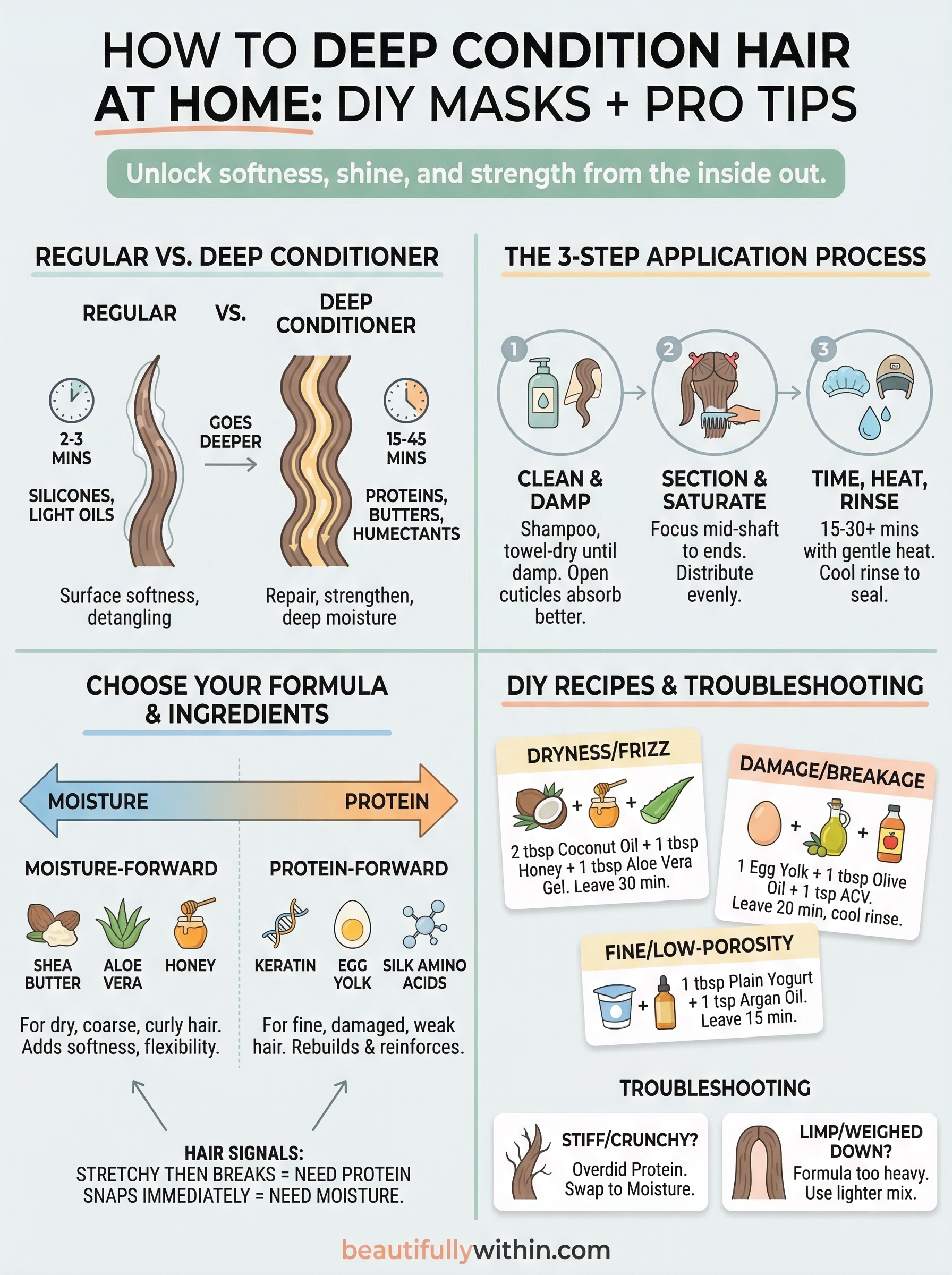
Quick recap and next steps
You now have everything you need to know about how to deep condition hair at home from start to finish. Choose a formula that matches your hair's actual need, whether that's moisture, protein, or a balance of both. Apply it to clean, damp hair from mid-lengths to ends, let it sit for at least 15 to 30 minutes with a little heat, and rinse with cool water to seal the cuticle shut. If a DIY recipe doesn't land perfectly the first time, change one ingredient and try again rather than scrapping the whole thing.
Consistency matters more than perfection here. One deep conditioning session a week will produce real, visible changes in texture and strength over the next few weeks. Ready to take your hair routine further? Browse our professional-grade hair care treatments to find targeted formulas built for your specific hair type and concerns.
✨ Shop the Look at Beautifully Within
Loved this guide? Discover our hand-picked picks that pair perfectly with your routine:
- 👉 32mm Ceramic Auto-Rotating Hair Curler — Hair Styling Tool
- 👉 Infrared Ionic Professional Hair Dryer — Hair Styling Tool
- 👉 Professional Blowout Brush — Hot Air Volumizing Styler — Hair Styling Tool
- 👉 5-in-1 Negative Ion Hot Air Styling Brush — Hair Styling Tool
New customer? Get 15% off orders $50+ with code WITHIN15 — plus free shipping over $75.
0 comments