

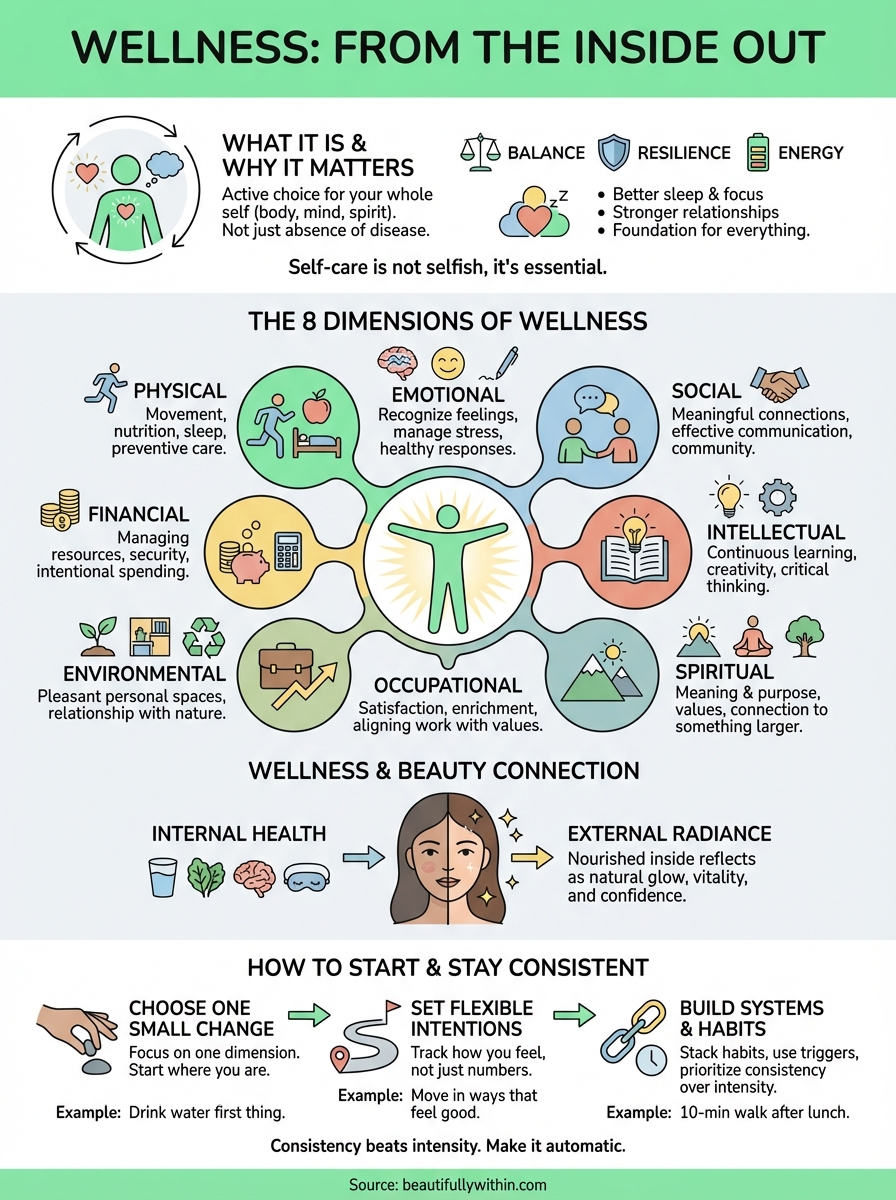
Wellness means taking care of your whole self. Not just your body or your mind, but everything that makes you feel alive and healthy. It includes how you move, what you eat, your relationships, your stress levels, and how you find meaning in your day. Think of it as an active choice to live in a way that helps you thrive.
This guide explains what wellness truly means and breaks down its eight core dimensions. You will learn why each area matters and how they connect to create your overall sense of wellbeing. We will also share practical ways to start your wellness journey right now, no matter where you are. Whether you want to feel more energized, sleep better, manage stress, or simply take better care of yourself, understanding these dimensions gives you a framework to build from. Wellness is not about perfection. It's about making small, consistent choices that add up over time. When you look and feel good from the inside out, it shows in everything you do.
Why wellness matters today
Your daily life demands more from you than ever before. You juggle work deadlines, family responsibilities, social commitments, and endless digital notifications. This constant pressure affects your physical health, mental clarity, and emotional balance. When you ignore these signs, small problems become bigger ones. You might feel tired all the time, struggle to focus, or notice your mood shifts more easily. Wellness gives you a framework to address these challenges before they control your life. It helps you build habits that protect your energy and keep you functioning at your best.
The real cost of neglecting self-care
When you skip meals, lose sleep, or push through stress without breaks, your body keeps score. You might develop chronic headaches, gain unwanted weight, or feel anxious for no clear reason. Your skin shows the strain through breakouts, dullness, or premature aging. Medical bills pile up as you treat symptoms instead of causes. Research shows that preventable lifestyle diseases account for the majority of health problems today. You lose productive time at work, miss moments with loved ones, and spend money on quick fixes that never quite solve the problem.
Taking care of yourself is not selfish. It's the foundation that lets you show up for everything else that matters.
What shifts when you prioritize wellness
Small changes create visible results faster than you expect. When you move your body regularly, you sleep better and think more clearly. Better food choices give you steady energy throughout the day instead of crashes. Managing stress helps you stay calm when problems arise. Your relationships improve because you have more patience and presence. You look in the mirror and see someone who takes care of themselves, and that confidence carries into every area of your life. Wellness is not about adding more tasks to your list. It's about making choices that multiply your capacity for everything you want to do.
How to start your wellness journey
Starting your wellness journey doesn't require a complete life overhaul or expensive equipment. You begin exactly where you are, with what you have. The key is to pick one small change that feels manageable and build from there. This approach prevents overwhelm and creates momentum that carries you forward naturally.
Choose your starting dimension
Look at the areas of your life that need the most attention right now. Maybe you notice your energy drops every afternoon, or you feel disconnected from the people around you. Perhaps stress keeps you awake at night, or you can't remember the last time you did something just for fun. Start with the dimension that causes you the most discomfort or offers the biggest immediate benefit. You don't need to address everything at once. Focus on one dimension, create a sustainable habit, then expand to another area. This sequential approach builds confidence and prevents the burnout that comes from trying to fix everything simultaneously.
Set intentions, not rigid goals
Wellness thrives on flexible intentions rather than strict rules. Instead of "I must exercise five days a week," try "I want to move my body in ways that feel good." Replace "I will never eat sugar" with "I choose foods that give me lasting energy." This shift removes the pressure that makes people quit. You create space for adaptation when life gets complicated. Track your progress by how you feel, not just numbers on a scale or checkboxes on a chart. Notice if you sleep better, handle stress more easily, or feel more present in conversations.
Your wellness journey is yours alone. What works for someone else might not fit your life, and that's completely normal.
Start with micro-habits
The smallest actions create the biggest shifts over time. Add one glass of water before your morning coffee. Take five deep breaths before checking your phone. Walk for ten minutes during your lunch break. These tiny changes require almost no time or effort, yet they compound into significant results. You build the habit of choosing wellness without triggering resistance. Once a micro-habit feels automatic, add another small change. Stack these habits together throughout your day. Before you realize it, you've created a lifestyle that supports your wellbeing without feeling like work.
What wellness really means
Wellness goes beyond the absence of disease. You can visit a doctor and receive a clean bill of health, yet still feel exhausted, disconnected, or unfulfilled. That gap between medical health and true wellbeing defines what wellness addresses. It represents an active pursuit rather than a passive state. You make intentional choices every day that either support or diminish your overall quality of life. Wellness recognizes that your physical condition, mental state, relationships, and sense of purpose all work together to create how you experience life.
The active nature of wellness
Traditional healthcare focuses on treating problems after they appear. Doctors diagnose illness, prescribe medication, and repair damage. Wellness takes the opposite approach. You identify what keeps you healthy and do more of it before problems develop. This proactive stance requires awareness of how your choices affect you. When you eat processed foods, you might notice brain fog or energy crashes. When you skip sleep, your patience thins and your immune system weakens. Wellness means paying attention to these signals and adjusting your behavior accordingly. You become the expert on your own body and life instead of waiting for symptoms to force action.
Wellness is not something you achieve and maintain forever. It's a continuous process of learning what your mind and body need.
Why wellness looks different for everyone
Your wellness needs differ from your neighbor's, your coworker's, or even your family member's. What energizes one person might drain another. Someone thrives on early morning workouts while you feel most alive moving your body in the evening. Your stress relief might come from quiet reading while others need social connection to recharge. Wellness respects these individual differences instead of forcing everyone into the same routine. You define success based on how you feel, not external standards. This personal approach makes wellness sustainable because you build a lifestyle that fits your actual life, preferences, and circumstances. The framework stays consistent, but the specific practices adapt to who you are and what you need right now.
The eight dimensions of wellness
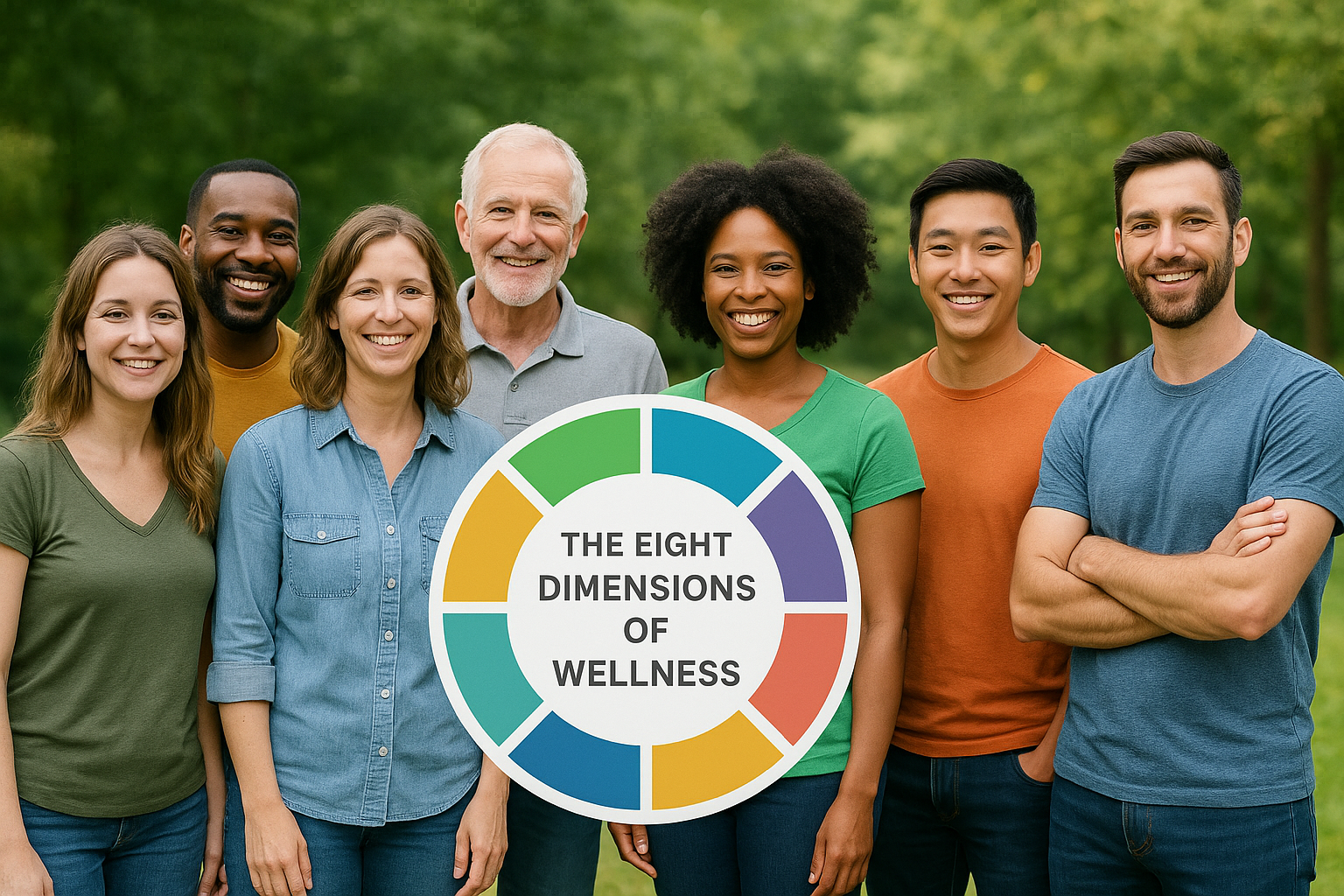
Wellness operates across eight interconnected areas of your life. Each dimension influences the others, creating a web of mutual support or strain. You don't need to excel in all eight areas simultaneously, but understanding each one helps you identify where to focus your attention. Some dimensions might feel strong right now while others need work. That imbalance is normal and gives you a clear starting point for improvement. Think of these dimensions as tools in your wellness toolkit, each serving a specific purpose in your overall health and happiness.
Physical wellness
Your body functions as the foundation for everything else you do. Physical wellness includes regular movement, nutritious eating, adequate sleep, and preventive care. You know this dimension needs attention when you feel tired despite sleeping, struggle with basic physical tasks, or notice your body hurting more often than it should. Start by tracking how much you actually move during a typical day. Most people sit far more than they realize. Add short movement breaks every hour, choose stairs over elevators when possible, and find activities that make you want to move rather than forcing yourself through exercise you hate. Pay attention to what you eat and how it makes you feel two hours later. Foods that cause energy crashes or brain fog don't serve you well, regardless of their nutritional labels.
Emotional wellness
Understanding and managing your feelings determines how you experience each day. Emotional wellness means recognizing your emotions as they arise, accepting them without judgment, and responding thoughtfully instead of reacting impulsively. You develop this dimension by creating space between what happens and how you respond. Notice when anxiety builds in your chest or when frustration tightens your shoulders. These physical sensations signal emotional states that need your attention. Practice naming your emotions specifically instead of using vague terms like "fine" or "stressed." The more precisely you identify what you feel, the better you can address the underlying cause. Build a toolkit of healthy responses such as deep breathing, journaling, or talking with someone you trust.
Social wellness
The quality of your relationships affects your health as much as diet or exercise. Social wellness focuses on building meaningful connections, communicating effectively, and contributing to your community. You thrive when you have people who genuinely know you and support your growth. This dimension suffers when you feel isolated, misunderstood, or surrounded by relationships that drain your energy. Evaluate your current connections honestly. Which relationships energize and uplift you? Which ones leave you feeling worse? You can't always eliminate difficult relationships, but you can set boundaries and invest more time in connections that nurture you. Quality matters more than quantity here. Three deep friendships provide more wellness benefit than thirty superficial acquaintances.
Your social health shapes your physical health in ways medicine is only beginning to understand fully.
Intellectual wellness
Your mind needs stimulation and challenge to stay sharp and engaged. Intellectual wellness involves continuous learning, creative expression, and problem-solving that stretches your thinking. This dimension keeps your brain healthy and builds confidence in your ability to navigate new situations. You neglect this area when your days blur together in routine, when you consume information passively without reflecting on it, or when you avoid challenges because they might be difficult. Feed your intellectual wellness by reading topics outside your usual interests, learning a new skill, or engaging in thoughtful discussions that challenge your perspective. Your brain grows stronger through use, just like your muscles. Even five minutes daily of focused learning compounds into significant growth over time.
Spiritual wellness
Finding meaning and purpose gives context to your daily experiences. Spiritual wellness connects you to something larger than yourself, whether that's nature, community, religious faith, or personal values. This dimension answers questions about why you're here and what matters most to you. You might feel disconnected from spiritual wellness when life feels empty despite external success, when you lack direction, or when you struggle to find motivation beyond basic obligations. Develop this area through reflection, meditation, time in nature, or participation in communities that share your values. Define what gives your life meaning, then align your choices with those priorities. This alignment creates a sense of peace and purpose that sustains you through difficult times.
Occupational wellness
The way you spend your working hours significantly impacts your overall wellbeing. Occupational wellness means finding satisfaction and enrichment through your work, whether that's paid employment, volunteering, or creative pursuits. This dimension thrives when your daily activities align with your skills and values, when you feel challenged but not overwhelmed, and when you see the positive impact of your contributions. Warning signs include dreading each workday, feeling your talents go unused, or experiencing constant stress related to your occupation. You improve this dimension by identifying what aspects of work energize you and finding ways to do more of that, setting clear boundaries between work and personal time, and pursuing opportunities that align with your strengths and interests.
Environmental wellness
Your surroundings shape your mood, energy, and health more than you might notice. Environmental wellness includes both your personal spaces and your relationship with the natural world. You feel better in clean, organized environments that reflect your personality and support your activities. This dimension also considers your impact on the planet and your connection to nature. Small changes create noticeable effects. Declutter one area of your home, add plants to your space, or spend fifteen minutes outside each day. These actions reduce stress and increase your sense of control over your environment. Your physical space either supports or hinders every other dimension of wellness, making this area a practical starting point for many people.
Financial wellness
Money stress affects your sleep, relationships, and health decisions. Financial wellness means managing your resources effectively and feeling secure about your financial future. This dimension doesn't require wealth, but it does require awareness of where your money goes and intentional choices about spending and saving. You build financial wellness by tracking expenses for one month to see actual patterns, creating a simple budget that reflects your values, and establishing an emergency fund even if you start with small amounts. Financial stress often stems from uncertainty more than actual numbers. When you understand your financial situation clearly and have a plan, anxiety decreases even before your bank balance changes significantly.
Wellness and beauty from the inside out
Your external appearance reflects your internal health more accurately than any beauty product can fake. When you prioritize wellness across all dimensions, your skin glows, your hair shines, and your energy becomes visible to everyone around you. This connection between inner health and outer beauty explains why some people seem to radiate vitality while others look tired despite expensive skincare routines. True beauty emerges when you nourish yourself completely, not just treat surface symptoms.
How internal health shows externally
Your skin reveals what happens inside your body. Dehydration causes dullness and fine lines regardless of how much moisturizer you apply. Poor sleep creates dark circles and puffiness that concealer can't fully hide. Chronic stress triggers breakouts, inflammation, and premature aging. Your hair tells a similar story. Nutritional deficiencies make it brittle and lifeless, while balanced eating creates natural shine and strength. Even your posture and the way you carry yourself changes when you feel genuinely well. You stand taller, move with more confidence, and naturally attract positive attention without trying.
When you feel good inside, you don't need to work as hard to look good outside.
The wellness-beauty connection
Beauty products work better when your foundation is strong. That expensive serum performs as promised when you also drink enough water, manage stress, and get quality sleep. Your makeup application improves when your skin is healthy and hydrated from within. Wellness practices like regular movement increase blood flow to your skin, delivering nutrients and oxygen that create a natural glow no highlighter can replicate. Emotional and social wellness show up in your eyes and smile. You can't fake the light that comes from genuine happiness and meaningful connections. This inside-out approach to beauty saves you money, time, and frustration because you address root causes instead of constantly covering up symptoms.
Simple habits to support each dimension
Building wellness into your daily life doesn't require dramatic lifestyle changes or hours of free time. You need specific, practical habits that fit into your existing routine and deliver real results. These simple actions target each dimension directly, giving you a clear path forward. Choose one or two habits from the areas that need the most attention right now, then add more as these become automatic parts of your day. The key is consistency over intensity. A five-minute habit you do every day creates more benefit than an hour-long effort you manage once a month.
Physical dimension habits
Drink a full glass of water immediately after waking up to rehydrate your body and jumpstart your metabolism. This single action takes thirty seconds and sets a positive tone for the rest of your day. Add a ten-minute walk after meals to aid digestion and break up long periods of sitting. You don't need special equipment or a gym membership for this habit to work. Keep healthy snacks visible and convenient in your kitchen, while storing less nutritious options out of sight. Your environment shapes your choices more than willpower does. Set a consistent bedtime and wake time, even on weekends, to regulate your body's natural sleep cycle. Track your actual sleep hours for one week to identify patterns that might need adjustment.
Emotional dimension habits
Start a simple journal where you write three feelings you noticed that day and what triggered them. This practice builds awareness without requiring perfect sentences or deep analysis. Create a personal calm-down toolkit with techniques that work for your specific stress responses, such as cold water on your wrists, counting backwards from one hundred, or squeezing a stress ball. Practice saying no to requests that drain your energy without guilt or lengthy explanations. A simple "That doesn't work for me" protects your emotional resources better than overcommitting. Schedule five minutes of complete stillness each day where you simply sit and breathe, noticing thoughts without following them. This micro-meditation builds the skill of observing your emotions rather than being controlled by them.
Your emotional habits shape your daily experience more powerfully than your circumstances do.
Social dimension habits
Text or call one person you care about each day with no agenda beyond connection. This habit strengthens relationships through consistent, small touchpoints rather than waiting for special occasions. Join one group or community that shares your interests, whether online or in person, and participate regularly instead of lurking. Active engagement creates relationships faster than passive observation. Set boundaries on relationships that consistently drain you by limiting contact time or choosing low-energy interaction methods like texting instead of phone calls. Learn to ask for help when you need it, starting with small, specific requests that make it easy for others to support you.
Intellectual dimension habits
Read for fifteen minutes about a topic outside your field before checking social media or email each morning. This habit feeds your curiosity when your mind is fresh and alert. Listen to educational podcasts or audiobooks during your commute or while doing household chores to transform dead time into learning opportunities. Take a different route home from work once a week to break routine and stimulate your brain with new observations. Challenge yourself with puzzles, strategy games, or learning apps that make you think in unfamiliar ways. Write down one new thing you learned each day, no matter how small, to reinforce the habit of active learning.
Spiritual dimension habits
Spend ten minutes in nature each day, even if that means sitting on your porch or walking around your block. This consistent exposure to the natural world reduces stress and creates perspective. Define your top three personal values and check decisions against them by asking, "Does this choice align with what matters most to me?" Review your day before sleep by identifying one moment of meaning or gratitude, which trains your brain to notice purpose throughout your day. Practice mindfulness during routine activities like washing dishes or brushing your teeth by focusing completely on the sensations instead of letting your mind wander.
Occupational dimension habits
Block thirty minutes of uninterrupted focus time each day for your most important work task, protecting this time from emails and meetings. Identify which work activities energize you and which drain you, then look for opportunities to adjust the balance even slightly in your favor. Take a real lunch break away from your workspace to reset your mental energy and return more productive than if you worked straight through. Update your skills in small increments by spending fifteen minutes weekly learning something relevant to your field or interests. Communicate clearly about your capacity when new requests arrive rather than automatically saying yes and creating overwhelm for yourself.
Environmental dimension habits
Declutter one small area each week, such as a drawer or shelf, to maintain organized spaces without dedicating entire weekends to cleaning. Add one plant to your living or working space to improve air quality and create a more calming atmosphere. Reduce waste by carrying reusable bags, water bottles, and food containers as standard parts of your routine. Spend your lunch break outside when weather permits to strengthen your connection with your surroundings. Open windows for fresh air circulation daily, even for just ten minutes, to improve indoor air quality.
Financial dimension habits
Check your bank balance and recent transactions every morning while drinking your coffee to stay aware of your financial reality without stress or avoidance. Save automatically by setting up a small transfer from checking to savings on the day you receive income, treating savings as a non-negotiable expense. Track every purchase for one week each month to identify spending patterns and make intentional adjustments. Wait twenty-four hours before making any unplanned purchase over fifty dollars to distinguish wants from needs. Review one subscription or recurring charge monthly and cancel anything that no longer provides clear value.
How to stay consistent over time
Consistency beats intensity when building lasting wellness habits. You won't maintain your progress through willpower alone because motivation naturally fluctuates with your mood, energy levels, and circumstances. The secret lies in creating systems that work even on difficult days. Your goal is to make wellness practices so integrated into your daily routine that skipping them feels harder than doing them. This shift from effortful choice to automatic behavior determines whether your wellness journey lasts months or decades.
Track your progress without obsessing
Write down one wellness metric you want to improve, then check it once per week at the same time and day. This regular monitoring keeps you aware of trends without creating anxiety about daily fluctuations. Choose metrics that actually reflect how you feel rather than arbitrary numbers that don't connect to your wellbeing. Your energy levels, sleep quality, stress response, and mood provide better feedback than scales or step counters alone. Notice patterns in your tracking data by asking what happened during weeks you felt best versus weeks you struggled. These insights reveal which habits deliver real results for your unique body and life.
Prepare for inevitable setbacks
Life will disrupt your wellness routine no matter how committed you are. You might get sick, face a work crisis, travel unexpectedly, or simply lose momentum for reasons you can't identify. Accept that these interruptions will happen instead of treating them as personal failures. Create a minimum viable routine you can maintain during chaotic periods, such as drinking enough water and getting outside for five minutes. This baseline keeps you connected to your wellness practice even when you can't do everything perfectly. Return to your full routine without guilt or shame as soon as circumstances allow. Each return strengthens your resilience and proves that temporary breaks don't erase your progress.
Your consistency matters more over months and years than over days and weeks.
Build systems that outlast motivation
Remove decisions from your wellness habits by establishing specific triggers that automatically cue each behavior. Put your workout clothes next to your bed so you see them immediately upon waking. Set up your coffee maker the night before to reduce morning friction. Link new habits to existing routines rather than relying on remembering to do them. Stack wellness practices together in sequences that flow naturally, such as stretching while your coffee brews or doing breathing exercises while stopped at red lights. These systems work because they bypass the need for motivation and leverage automatic behaviors you already perform daily.
Bringing wellness into your life
Your wellness journey begins with one intentional choice today, not a perfect plan for tomorrow. You now understand the eight dimensions that shape your overall wellbeing and have practical habits for each area. The power lies in taking action on what resonates most with your current needs rather than trying to transform everything simultaneously.
Start where you are and build gradually. Choose one dimension that needs attention, implement a single habit, and let that success motivate your next step. Remember that wellness shows up not just in how you feel inside but also in how you look and present yourself to the world. When you nourish your body, mind, and spirit consistently, that inner vitality radiates outward through your skin, energy, and confidence.
Explore products and resources that support your wellness goals at Beautifully Within, where beauty and wellness work together to help you thrive from the inside out.
✨ Shop the Look at Beautifully Within
Loved this guide? Discover our hand-picked picks that pair perfectly with your routine:
- 👉 Hydrogen-Infused Wellness Water Bottle — Wellness Device
- 👉 EMS Wireless Neck Massager with Remote Control — Wellness Device
- 👉 360° Air Compression Leg Massager — Wellness Device
New customer? Get 15% off orders $50+ with code WITHIN15 — plus free shipping over $75.
0 comments